
10 Essential Cloud Security Tips to Protect Your Data in 2026
Cloud computing has transformed how individuals and businesses store, manage, and access data. Instead of relying on physical servers, data is now stored in remote data centers and accessed via the internet, making operations faster, scalable, and more flexible.
However, this convenience comes with serious risks. In 2025 alone, over 94% of organizations experienced at least one cloud security incident, showing how widespread threats have become . Cyberattacks are evolving rapidly, targeting misconfigurations, weak credentials, and unsecured APIs.
That’s why cloud security is more important than ever in 2026. Without proper protection, sensitive data can be exposed, stolen, or even permanently lost. Learn 10 practical cloud security tips that will help you protect your data and reduce risks in today’s fast-changing digital landscape.
Why Cloud Security Matters More Than Ever
Cloud computing is no longer just a trend—it’s the backbone of modern business. From startups to global enterprises, organizations rely on cloud platforms to store sensitive data, run applications, and manage daily operations. While this shift brings speed and flexibility, it also introduces new security challenges that can’t be ignored.
One of the biggest reasons cloud security is more critical today is the rapid growth of cloud adoption. Businesses now use multiple cloud services at once—often a mix of public, private, and hybrid environments. This increases complexity and makes it harder to track who has access to what. Without proper controls, it’s easy for sensitive data to be exposed unintentionally.
At the same time, cyberattacks targeting cloud systems are increasing. Hackers are no longer focusing only on traditional IT infrastructure—they actively look for weak cloud configurations, stolen credentials, and unsecured APIs. Because cloud environments are accessible over the internet, they become attractive targets for attackers worldwide.
Another key issue is the growing amount of sensitive data stored in the cloud. Personal information, financial records, business secrets, and customer data are all stored online. If this data is not properly protected, it can lead to serious consequences such as financial loss, legal penalties, and damage to a company’s reputation.
What makes the situation even more challenging is that many cloud security incidents are caused by simple mistakes—like misconfigured storage, weak passwords, or excessive user permissions. This means that even small errors can lead to major data breaches.
That’s why following proven cloud security tips is more important than ever. As cloud technology continues to evolve in 2026 and beyond, organizations and individuals must take a proactive approach to security—protecting their data before threats become real problems.
Read More: Carcassonne Game: Complete Guide to Rules, Strategy & How to Play for Beginners
Use Strong Identity and Access Management IAM
One of the most important cloud security tips is making sure the right people have the right level of access—no more, no less. This is where Identity and Access Management (IAM) comes in.
IAM is a framework that helps you control who can access your cloud resources, what they can do, and when they can do it. Without proper IAM, users may have unnecessary permissions, which increases the risk of data breaches if an account is compromised.
A common mistake in cloud environments is giving users more access than they actually need. This is known as over-privileged access, and it creates serious security gaps. For example, if an employee only needs to view data but has permission to edit or delete it, a simple mistake—or a hacked account—can cause major damage. To strengthen your IAM strategy, start by applying the principle of least privilege (PoLP). This means:
- Users only get access to what they need for their job
- Permissions are limited and regularly reviewed
- Access is removed when it’s no longer required
Another best practice is to use role-based access control (RBAC). Instead of assigning permissions to individuals, you assign roles (like “admin,” “developer,” or “viewer”), and users inherit permissions based on their role. This makes access management more organized and secure.
You should also:
- Regularly audit user accounts and permissions
- Disable inactive or unused accounts
- Monitor login activity for suspicious behavior
Strong IAM acts as the first line of defense in your cloud environment. Even if attackers manage to steal login credentials, well-managed access controls can limit what they can do. In short, controlling access properly is one of the most effective cloud security tips to protect your data and reduce the risk of unauthorized access.
Enable Multi-Factor Authentication MFA
Another essential step in protecting your cloud environment is enabling Multi-Factor Authentication (MFA). It’s one of the simplest yet most powerful cloud security tips you can implement. MFA adds an extra layer of security beyond just a password. Instead of relying on a single login credential, it requires users to verify their identity using at least two factors:
- Something you know (password or PIN)
- Something you have (a mobile device or authentication app)
- Something you are (biometric verification like fingerprint or face recognition)
The problem with passwords alone is that they can be easily stolen, guessed, or reused across multiple accounts. Cybercriminals often use phishing attacks or data leaks to gain access to login credentials. Once they have a password, they can enter a system without any resistance—unless MFA is enabled. With MFA in place, even if a hacker gets your password, they still can’t access your account without the second verification step. This significantly reduces the risk of unauthorized access.
To make the most of MFA:
- Enable it for all users, especially administrators
- Use authentication apps instead of SMS when possible (more secure)
- Require MFA for sensitive actions like changing passwords or accessing critical data
Many major cloud providers offer built-in MFA features, but they are not always enabled by default. That’s why turning it on should be a top priority. Alone is no longer enough. Enabling MFA is one of the most effective cloud security tips to protect your accounts and keep your data safe.
Encrypt Your Data At Rest and In Transit
Encryption is one of the most powerful cloud security tips you can use to protect sensitive information. It works by converting your data into unreadable code, so even if someone gains unauthorized access, they won’t be able to understand or use it. In cloud environments, data is constantly moving and being stored in different locations. That’s why you need to protect it in two key states:
Data at rest: This refers to data stored in cloud servers, databases, or storage systems. Encrypting data at rest ensures that if storage is compromised, the information remains secure.
Data in transit: This is data being transferred between systems, such as from your device to a cloud server. Encryption here prevents attackers from intercepting and reading the data during transmission.
Without encryption, sensitive information like passwords, financial data, or personal records can be exposed in plain text. This makes it easy for cybercriminals to exploit.
To implement strong encryption:
- Use industry-standard protocols like TLS (Transport Layer Security) for data in transit
- Enable server-side encryption provided by your cloud provider
- Consider client-side encryption for highly sensitive data
- Manage encryption keys securely and restrict access to them
Many cloud platforms offer built-in encryption tools, but they are not always configured properly by default. That’s why it’s important to review your settings and ensure encryption is fully enabled.
In simple terms, encryption acts like a digital lock on your data. Even if attackers break in, they won’t be able to read what they steal. That’s why encrypting your data both at rest and in transit is a critical part of any strong cloud security strategy.
Regularly Update and Patch Systems
Keeping your systems updated is one of the most overlooked yet critical cloud security tips. Many cyberattacks don’t rely on advanced hacking techniques—they simply exploit known vulnerabilities in outdated software.
Every cloud platform, application, and operating system regularly releases updates and security patches. These updates are designed to fix bugs, close security gaps, and improve overall performance. When you delay or ignore them, you leave your system exposed to threats that attackers already know how to exploit.
Hackers often scan cloud environments for outdated software because it’s an easy entry point. Once they find a vulnerability, they can gain access, steal data, or even take control of systems.
To stay protected:
- Apply updates as soon as they are released
- Enable automatic patching whenever possible
- Regularly update operating systems, applications, and third-party tools
- Remove or replace unsupported (end-of-life) software
It’s also important to test updates in a controlled environment before deploying them widely, especially in business-critical systems. This helps avoid compatibility issues while still maintaining security.
Another smart practice is to maintain an inventory of all your cloud assets. This ensures nothing is missed when updates are rolled out.
In short, ignoring updates is like leaving your front door unlocked. Regular patching closes security gaps and keeps your cloud environment protected from known threats—making it one of the most essential cloud security tips you should never.
Backup Your Data Regularly
Regular data backup is one of the most practical and reliable cloud security tips for protecting your information from unexpected loss. Even with strong security measures in place, data can still be lost due to cyberattacks, system failures, accidental deletion, or natural disasters.
One of the biggest modern threats is ransomware. In these attacks, hackers encrypt your data and demand payment to restore access. If you don’t have a proper backup, you may be forced to either lose your data or pay the ransom. However, with a secure backup system, you can restore your files without giving in to attackers.
To build a strong backup strategy, follow these best practices:
- Follow the 3-2-1 rule: Keep 3 copies of your data, store them on 2 different types of storage, and keep 1 copy offsite (or in a separate cloud region).
- Automate backups: Schedule regular backups so you don’t rely on manual processes.
- Use versioning: Keep multiple versions of files so you can recover earlier data if needed.
- Test your backups: Regularly check if you can restore data successfully—not just if backups are being created.
Many cloud providers offer built-in backup and recovery tools, but they must be properly configured and monitored. Simply having backups is not enough—you need to ensure they are secure, up to date, and accessible when needed.
In today’s threat environment, data loss can happen in seconds but recovery takes time unless you are prepared. That’s why regular backups remain one of the most essential cloud security tips for ensuring business continuity and protecting valuable information.
Conclusion
Cloud computing has made it easier than ever to store, manage, and access data—but it has also introduced new security risks that cannot be ignored. As cyber threats continue to evolve in 2026, protecting your cloud environment is no longer optional; it is a necessity.
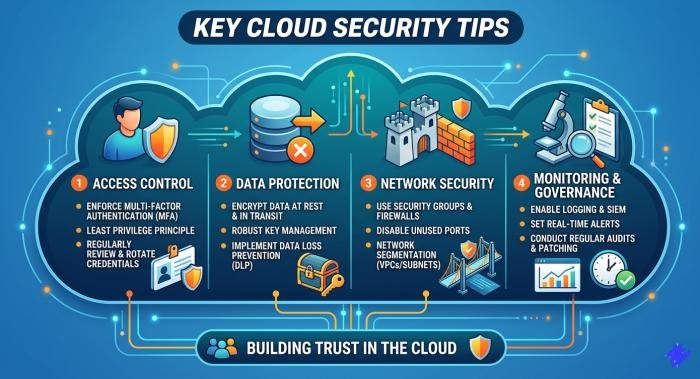
In this guide, we explored 10 essential cloud security tips, including strong identity management, multi-factor authentication, data encryption, regular system updates, secure backups, and more. Each of these practices plays a critical role in reducing vulnerabilities and strengthening your overall security posture.
The key takeaway is simple: cloud security is not a one-time setup—it is an ongoing process. Regular monitoring, updates, and awareness are required to stay ahead of modern cyber threats. Consistently applying these cloud security tips, individuals and businesses can significantly reduce the risk of data breaches, protect sensitive information, and ensure long-term digital safety.
FAQs
Q1. What are cloud security tips?
Ans: Cloud security tips are best practices and strategies used to protect data, applications, and systems stored in cloud environments. They help prevent cyberattacks, data breaches, and unauthorized access.
Q2. Why are cloud security tips important in 2026?
Ans: In 2026, cyber threats are becoming more advanced and frequent. Following cloud security tips helps individuals and businesses protect sensitive data, reduce risks, and maintain secure cloud operations.
Q3. What is the biggest risk in cloud security?
Ans: One of the biggest risks is misconfiguration, such as improperly set permissions or unsecured storage. Weak passwords and lack of encryption also increase vulnerability to attacks.
Q4. How does Multi-Factor Authentication improve security?
Ans: Multi-Factor Authentication (MFA) adds an extra layer of protection by requiring more than just a password to log in. Even if a password is stolen, attackers cannot access the account without the second verification step.
Q5. Why is data encryption important in cloud security?
Ans: Encryption protects data by converting it into unreadable code. This ensures that even if data is intercepted or stolen, it cannot be understood or misused without the encryption key.
Q6. How often should cloud systems be updated?
Ans: Cloud systems should be updated as soon as security patches are released. Regular updates help fix vulnerabilities and protect against known cyber threats.
Q7. What is the most effective cloud security tip overall?
Ans: There is no single solution, but combining strong IAM, MFA, encryption, and regular backups creates a strong security foundation. A layered approach is the most effective way to secure cloud environments.