
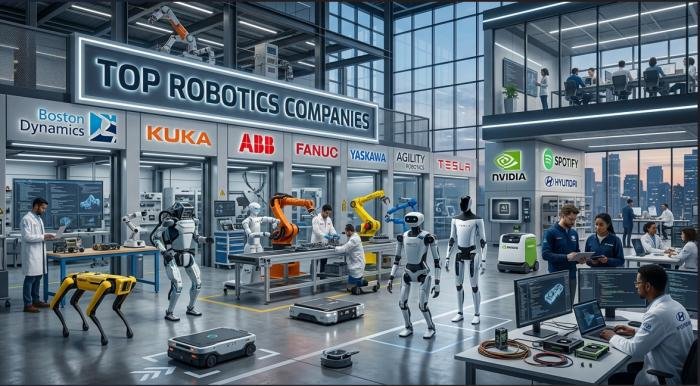
Top Robotics Companies in 2026: Leading Firms Across Key Industries
Robotics is changing how businesses manufacture products, manage warehouses, perform surgery, and deliver services top robotics companies. From robotic arms on automobile assembly lines to autonomous machines moving packages through distribution centers, robots are becoming an important part of modern industry.
As artificial intelligence (AI), sensors, and automation software improve, businesses are searching for dependable robotics partners that can solve practical problems and deliver measurable results. However, choosing a manufacturer is not always easy because different companies specialize in different technologies.
This guide to the top robotics companies highlights 12 established manufacturers and innovative technology providers operating across industrial, commercial, medical, and consumer robotics. It explains their strengths, applications, and potential advantages so readers can make better-informed decisions.
The companies are presented as a practical, category-based selection rather than a strict revenue ranking. Robotics businesses operate in different markets, so their performance cannot be compared fairly using a single measurement.
What Makes a Robotics Company a Market Leader?
A strong robotics company does more than manufacture machines. It combines mechanical engineering, software, control systems, safety features, and technical support to help customers automate real-world tasks.
Read More: Contact Address Imagineergames: Address, Support & Contact Methods
Innovation and technological capability
Leading manufacturers invest in robotic motion, machine vision, sensing, AI, and automation software. These technologies help robots perform repetitive work, navigate complex environments, and maintain accuracy.
Innovation is especially important in warehouses, hospitals, and factories where operating conditions can change throughout the day.
Reliability, scalability, and customer support
A robot must work consistently in its intended environment. Buyers should consider uptime, maintenance requirements, replacement parts, integration costs, training, and local technical support.
The top robotics companies are not necessarily the ones with the most advanced demonstrations. For many businesses, the best partner is the manufacturer that delivers reliable performance and a realistic return on investment.
Top Robotics Companies in 2026
The following companies represent different areas of robotics, including industrial manufacturing, collaborative automation, logistics, medical procedures, and autonomous machines. Their inclusion reflects their established presence or notable technology in these segments, not a universal ranking.
1. FANUC
Headquarters: Japan
Specialty: Industrial robots, CNC systems, and factory automation
FANUC is a major name in industrial robotics and manufacturing automation. Its robotic arms are used in applications such as welding, painting, material handling, assembly, and machine tending. The company is particularly relevant to manufacturers that need repeatable performance across high-volume production lines. Its broader factory automation portfolio also includes CNC controls and other technologies that support automated manufacturing.
FANUC may suit automotive suppliers, electronics producers, and industrial facilities looking to standardize repetitive operations. Buyers should compare the robot’s payload, reach, cycle time, controller compatibility, and service availability before making a purchase.
2. ABB Robotics
Headquarters: Switzerland
Specialty: Industrial robots, collaborative automation, and robotic software
ABB Robotics serves manufacturers across industries such as automotive, electronics, logistics, and general manufacturing. Its portfolio includes robotic arms, automation software, and solutions designed to coordinate machines with production processes. One of ABB’s strengths is its experience in integrating robotics into broader industrial environments.
Businesses can evaluate its solutions for welding, picking, assembly, material handling, and other production tasks. ABB announced a plan in April 2025 to separate its robotics business, with a planned transaction timeline in 2026. Buyers evaluating a contract should verify the current corporate structure, product support arrangements, and commercial terms.
3. Yaskawa Electric
Headquarters: Japan
Specialty: Industrial robots, servo motors, and motion control
Yaskawa Electric is widely recognized for its Motoman industrial robot range and motion-control technology. Its systems support manufacturing tasks such as arc welding, assembly, handling, and machine loading. The combination of robotics and motion control makes Yaskawa relevant to factories that require precise, coordinated movements.
It can be a suitable candidate for businesses seeking automation across multiple production stages. When comparing Yaskawa with other top robotics companies, examine programming requirements, integration with existing equipment, payload capacity, and maintenance support rather than relying on brand reputation alone.
4. KUKA
Headquarters: Germany
Specialty: Industrial robotic arms and integrated automation
KUKA develops robots and automation systems for manufacturing and industrial applications. Its technologies are associated with automotive production, welding, material handling, assembly, and flexible manufacturing cells. KUKA is worth considering when a business needs robotic equipment that can be integrated into a larger production line.
Its suitability depends on the specific application, the complexity of the installation, and the skills of the integration team. For companies planning a factory upgrade, a complete project assessment should include safety equipment, fixtures, programming, installation, and ongoing servicing—not just the robot’s purchase price.
5. Universal Robots
Headquarters: Denmark
Specialty: Collaborative robots, commonly called cobots
Universal Robots focuses on collaborative robotic arms designed to automate tasks in manufacturing and other workplaces. Cobots can be useful for machine tending, screwdriving, packaging, inspection, and repetitive assembly. Their appeal often lies in flexible deployment and the ability to automate individual workstations without redesigning an entire production line.
However, the term collaborative does not mean that every setup is automatically safe for direct human contact. A proper risk assessment and suitable safety measures remain necessary. Universal Robots may be a good starting point for small and medium-sized businesses that want to automate selected tasks gradually.
Comparison of Leading Robotics Companies
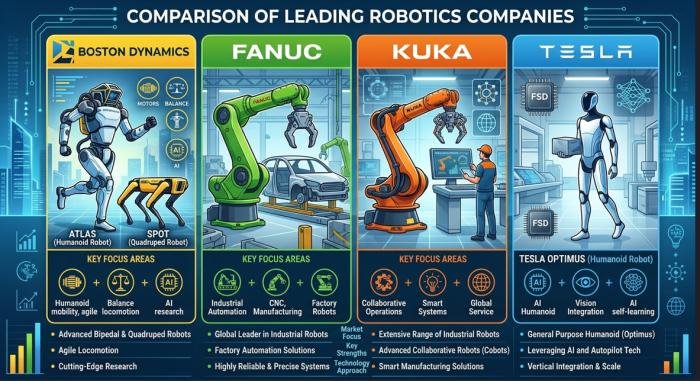
| Company | Main specialization | Potential use case | Best suited for |
| FANUC | Industrial robotics | Welding and machine tending | High-volume factories |
| ABB Robotics | Industrial automation | Assembly and material handling | Large and medium manufacturers |
| Yaskawa Electric | Robotics and motion control | Welding and production automation | Industrial facilities |
| KUKA | Robotic arms and automation | Flexible manufacturing | Complex production lines |
| Universal Robots | Collaborative robots | Assembly and packaging | Flexible workstations |
| Boston Dynamics | Mobile and legged robots | Inspection and logistics | Advanced industrial projects |
| Amazon Robotics | Warehouse robotics | Inventory movement | Fulfillment operations |
| Intuitive Surgical | Surgical robotics | Robot-assisted procedures | Hospitals and surgical teams |
| Kawasaki Robotics | Industrial robotics | Handling and welding | Manufacturing plants |
| Mitsubishi Electric | Factory automation | Assembly and electronics production | Integrated automation projects |
| DJI | Aerial robotics | Inspection and surveying | Commercial drone operators |
| Unitree Robotics | Legged and humanoid robots | Research and development | Robotics labs and pilot projects |
Industries Benefiting from Robotics Technology
Robotics has moved into many sectors, but its practical value depends on the task being automated and the environment in which the machine operates.
Manufacturing and automotive production
Factories use robots for welding, painting, assembly, packaging, and repetitive material handling. Automation can improve consistency and reduce exposure to hazardous or physically demanding work.
Industrial manufacturers such as FANUC, ABB, Yaskawa, and KUKA are relevant to businesses evaluating these applications.
Warehousing and logistics
Warehouses use mobile robots, automated storage systems, and robotic picking equipment to move goods and support order fulfillment. These technologies can help manage repetitive transport tasks and improve workflow coordination.
A successful installation requires careful planning around warehouse layouts, inventory systems, pedestrian routes, and peak demand.
Healthcare and medical procedures
Medical robotics supports selected surgical procedures, rehabilitation activities, and laboratory workflows. These systems must meet applicable safety and regulatory requirements and be operated by appropriately trained professionals.
Healthcare buyers should evaluate clinical evidence and operational costs rather than assuming that robotic technology automatically improves every procedure.
Agriculture, inspection, and research
Robots and drones can support crop monitoring, surveying, infrastructure inspection, and scientific experiments. In these applications, navigation, sensor quality, environmental conditions, and data processing can matter as much as physical movement.
How to Choose the Right Robotics Company
Selecting a robotics supplier requires more than comparing product specifications. A structured evaluation can reduce purchasing risks and improve the likelihood of a successful deployment.
1. Define the task. Identify the process you want to automate, including its frequency, required accuracy, working conditions, and current cost.
2. Establish a realistic budget. Account for the robot, software, integration, fixtures, safety systems, installation, training, maintenance, and potential downtime.
3. Check technical compatibility. Confirm payload, reach, cycle time, environmental protection, controller interfaces, and compatibility with existing equipment.
4. Evaluate safety requirements. Assess risks to workers and nearby equipment. Install appropriate guarding, sensors, emergency stops, or other protective measures as required by the application.
5. Review service and support. Ask about spare parts, response times, training, warranty terms, software updates, and local service partners.
6. Run a pilot project. Test the robot on a clearly defined task before committing to a larger deployment. Measure throughput, quality, uptime, and operating cost.
When evaluating the top robotics companies, businesses should request application-specific demonstrations and comparable quotations. A robot that performs well in a controlled demonstration may need additional engineering to succeed in a real production environment.
Robotics Industry Trends in 2026
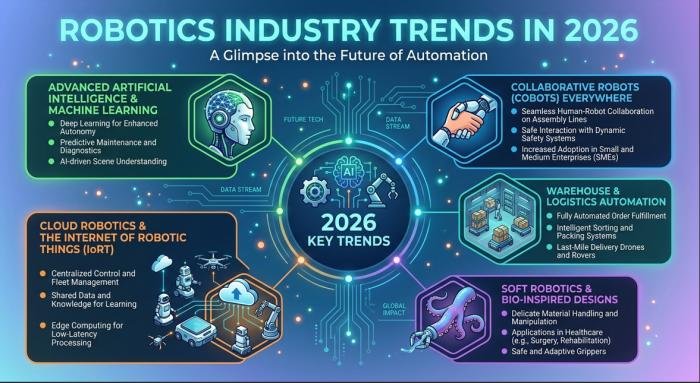
Several developments are influencing robotics research and adoption in 2026.
AI-powered robotics: AI is helping robotic systems interpret sensor data, recognize objects, and adapt to changing conditions. However, reliability still depends on the application, the quality of training and testing, and the safety controls surrounding the system.
Humanoid robots: Humanoid robots continue to attract investment and research interest. Their long-term potential includes handling tasks in human-designed environments, but reliable performance, operating costs, and large-scale deployment remain important challenges.
More flexible automation: Manufacturers increasingly seek systems that can handle product variations and changing production requirements. Collaborative robots and adaptable automation cells may help businesses automate tasks without rebuilding entire facilities.
Growth in mobile robotics: Autonomous mobile robots are being used to transport materials and support logistics. Their value depends on safe navigation, fleet coordination, battery management, and integration with business software. Overall, the top robotics companies will be those that combine technological progress with practical reliability, support, and measurable customer value. New capabilities are important, but commercial results matter just as much.
Final Thoughts
The robotics industry is expanding across manufacturing, healthcare, logistics, research, and commercial services. Established manufacturers provide proven automation technologies, while newer robotics developers are advancing mobility, AI, and humanoid systems.
Choosing among the top robotics companies starts with understanding your requirements. A manufacturing plant may prioritize speed and repeatability, a warehouse may need autonomous material transport, and a hospital may require a specialized medical platform supported by clinical evidence and regulatory compliance.
Before making a decision, compare technical capabilities, total ownership costs, safety requirements, integration complexity, and after-sales service. Whenever possible, test the technology in a real operating environment and measure its performance against clear business goals.
Frequently Asked Questions FAQs
Q1: What are the top robotics companies in 2026?
Ans: The top robotics companies depend on the industry and application. FANUC, ABB Robotics, Yaskawa, and KUKA are established industrial automation providers, while Boston Dynamics, Intuitive Surgical, DJI, and Unitree specialize in different areas of robotics.
Q2: Which company is best for industrial robotics?
Ans: FANUC, ABB Robotics, Yaskawa, and KUKA are strong candidates for industrial automation. The best choice depends on the required payload, precision, production speed, integration needs, budget, and local technical support.
Q3: Which robotics companies manufacture humanoid robots?
Ans: Unitree Robotics and Boston Dynamics are notable participants in legged and humanoid robotics. Other developers, including Tesla and Figure AI, are also working on humanoid platforms. Commercial readiness varies by product and application.
Q4: Are robotics companies a good choice for manufacturing businesses?
Ans: Robotics companies can help manufacturers automate repetitive tasks, improve consistency, and reduce exposure to hazardous work. Businesses should calculate the total cost of ownership and evaluate expected productivity improvements before investing.
Q5: Which robotics companies are best for warehouse automation?
Ans: Amazon Robotics and Boston Dynamics are notable names in warehouse automation, while other specialist providers focus on autonomous mobile robots, picking, and inventory movement. The right solution depends on warehouse size, workflow, and software compatibility.