Carcassonne Game: Complete Guide to Rules, Strategy & How to Play for Beginners
The Carcassonne game is one of the most popular tile-based board games in the world, known for its simple mechanics and deep strategic gameplay. Set in a medieval landscape, players build cities, roads, monasteries, and fields by placing tiles while using their meeples to claim territory and earn points. Each move requires careful thinking, making the game both relaxing and competitive at the same time.
Whether you’re new to board games or looking to improve your skills, this guide will walk you through everything you need to know—from setting up the game and understanding the rules to learning scoring methods and winning strategies. By the end of this guide, you’ll feel confident playing Carcassonne and enjoy every session with friends and family.
What Is the Carcassonne Game
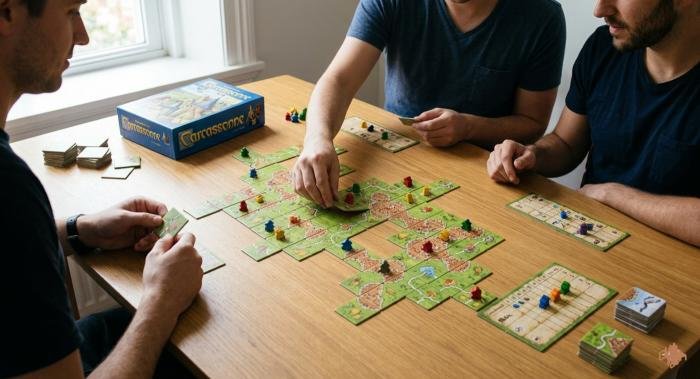
The Carcassonne game is a tile-placement board game where players build a medieval landscape by placing tiles that feature cities, roads, monasteries, and fields. As the board grows, players strategically place their pieces known as meeples to claim and control these features, earning points by completing them.
Originally released in 2000 and named after the fortified city of Carcassonne in France, the game quickly gained global popularity. It went on to win the prestigious Spiel des Jahres (Game of the Year), which helped establish it as a modern classic in the board gaming world.
What makes the Carcassonne game especially appealing is its perfect balance between simplicity and strategy. The rules are easy to learn, yet the game offers deep tactical choices and replayability, making it enjoyable for both beginners and experienced players alike.
Read More: Grand Theft Auto VI: Release Date, Gameplay, and Latest Updates
What Comes in the Carcassonne Game Box
When you open the Carcassonne game box, you’ll find a set of components designed to create a unique medieval landscape every time you play. The contents are simple but highly versatile, allowing for endless gameplay possibilities.
Landscape Tiles: The game includes a collection of square tiles that represent different features such as cities, roads, monasteries, and fields. These tiles are the core of the game, as players draw and place them to build the map during gameplay.
Meeples Player Pieces: Each player receives a set of small wooden figures called meeples. These are used to claim parts of the board—like cities or roads—and earn points. Managing your meeples wisely is key to winning.
Starting Tile: There is a special starting tile that begins the game. All players build outward from this tile as they place new ones.
Scoreboard and Scoring Markers: The box includes a scoring track where players keep track of their points throughout the game using markers.
Rulebook: A detailed instruction manual explains the rules, setup, and scoring system, making it easy for beginners to learn. Some editions may also include mini-expansions or additional tiles, adding more variety and strategy to the game.
Carcassonne Game Setup Step-by-Step
Setting up the Carcassonne game is quick and easy, making it perfect for beginners. Follow these simple steps to get started:
Place the Starting Tile: Begin by placing the starting tile face-up in the center of the table. This tile is usually marked on the back and serves as the foundation of the game board.
Shuffle the Remaining Tiles: Mix all the other landscape tiles face-down and place them in stacks or a draw pile within reach of all players.
Give Each Player Meeples: Each player chooses a color and takes their set of meeples (typically 7 or 8 pieces, depending on the version).
Set Up the Scoreboard: Place the scoring board nearby and give each player a scoring marker. Set all markers to zero at the start.
Decide the First Player: Choose a starting player randomly. You can pick the youngest player or use any fair method.
Start the Game: The first player draws a tile from the pile and places it next to the starting tile, matching the edges correctly (city to city, road to road, etc.). The game then continues clockwise. Once these steps are complete, you’re ready to begin building your medieval landscape and competing for points!
Carcassonne Game Rules Explained Simply
The rules of the Carcassonne game are easy to learn, which is why it’s perfect for beginners. Each turn follows a simple structure, but the choices you make can greatly affect your final score.
Draw and Place a Tile
At the start of your turn, draw one tile from the face-down pile. You must place it on the board so that it matches the surrounding tiles. For example, roads must connect to roads, cities to cities, and fields to fields. If a tile cannot be placed anywhere, it is removed from the game (this is rare).
Place a Meeple Optional
After placing your tile, you may place one of your meeples on that tile. You can choose to place it on a city, road, monastery, or field. However, you cannot place a meeple on a feature that is already occupied by another player’s meeple.
Complete Features to Score Points
Points are earned when features are completed:
- Cities are completed when fully enclosed
- Roads are completed when both ends connect
- Monasteries are completed when surrounded by tiles
Continue Taking Turns
Players take turns clockwise, repeating the same steps: draw a tile, place it, optionally place a meeple, and score points if any features are completed.
End of the Game
The game ends when all tiles have been placed. Players then count final points for incomplete features, and the player with the highest score wins.
These simple rules make Carcassonne easy to pick up, while still offering plenty of strategy and decision-making in every turn.
How Scoring Works in the Carcassonne Game
Understanding scoring in the Carcassonne game is key to improving your strategy and winning more often. Points are awarded both during the game and at the end.
Scoring During the Game
Players earn points immediately when they complete certain features on the board. Once a feature is finished, the meeple used is returned to the player, making it available for future turns.
- Cities: Completed cities score points for each tile used, with bonus points for shields (if present).
- Roads: Completed roads score points based on the number of tiles in the road.
- Monasteries: A monastery is complete when it is surrounded by 8 tiles, earning maximum points.
End Game Scoring
At the end of the carcassonne game:
- Incomplete features still give points, but usually fewer.
- Fields (farms) are scored based on completed cities they connect to.
This final scoring phase can significantly change the outcome of the game.
How to Play the Carcassonne Game Example Turn
To better understand how the Carcassonne game works, let’s walk through a simple example of a player’s turn:
Draw a Tile: You pick one tile randomly from the face-down pile. For example, you draw a tile that has a road and part of a city.
Place the Tile: You must place the tile on the board so that all edges match correctly. The road must connect to another road, and the city must connect to an existing city edge. You rotate the tile until it fits and place it on the board.
Place a Meeple Optional: After placing the tile, you decide whether to place a meeple. In this case, you place your meeple on the road to claim it. Remember, you can only place a meeple if no other player already has one on that connected feature.
Check for Completion: If your tile completes a feature like finishing a road you immediately score points. For example, if the road now has 4 tiles, you earn 4 points.
Retrieve Your Meeple: Since the road is complete, your meeple is returned to you and can be used again in future turns. This simple turn structure draw, place, optionally claim, and score is repeated by each player until all tiles are used.
Best Carcassonne Game Strategies for Beginners
To get better at the Carcassonne game, you don’t need complex tactics at the start. Instead, focus on simple, practical strategies that help you score consistently and avoid common mistakes.
Focus on small cities early
Small cities are easier to complete and give quick points. As a beginner, this helps you build momentum without risking unfinished projects that may never score.
Use meeples wisely
Meeples are limited, so avoid placing them on every opportunity. Try to keep at least one or two available for better chances later in the game.
Block opponents strategically
Pay attention to what other players are building. Sometimes placing a tile that disrupts their city or road can stop them from scoring big points.
Balance risk vs reward
Large cities and long roads offer high rewards but take time and effort to complete. Mix both small safe plays and bigger risky strategies for the best results.
Control the board early
Try to influence the board shape in the early game. The more control you have over tile placement, the more options you’ll have later. By applying these simple strategies, you’ll quickly improve your gameplay and make smarter decisions each turn in Carcassonne.
Why the Carcassonne Game Is So Popular
The Carcassonne game has remained one of the most loved modern board games since its release because it strikes a rare balance between simplicity and depth.
Easy to learn, hard to master
The rules are simple enough for beginners to understand within minutes, but the strategic depth keeps experienced players engaged for years.
Highly replayable
No two games are ever the same. Since tiles are drawn randomly and the board constantly changes, every match feels fresh and unpredictable.
Perfect for all ages
Carcassonne works well for families, casual players, and competitive gamers. It doesn’t require complex calculations, making it accessible to almost anyone.
Quick gameplay
A full game usually takes around 30–45 minutes, which makes it ideal for both short sessions and repeated play.
Strategic but not overwhelming
Unlike many heavy strategy games, Carcassonne offers meaningful decisions without feeling too complicated or stressful.
Expansions add variety
The game also has many expansions that introduce new rules and mechanics, keeping it exciting even after many plays.
Because of this combination of accessibility, strategy, and replay value, Carcassonne continues to be a favorite in board game collections around the world.
Final Thoughts
The Carcassonne game is a perfect example of how simple rules can create deep and engaging gameplay. With just a few basic mechanics—drawing tiles, placing them strategically, and using meeples—you can build an ever-changing medieval landscape filled with competition and creativity.
What makes Carcassonne truly special is its balance. It is easy enough for beginners to learn quickly, yet it still offers meaningful strategic decisions that keep experienced players coming back. Every game feels different, which adds to its long-lasting appeal.
If you’re new to board games, Carcassonne is an excellent starting point. And if you’re already a fan, it’s a game that continues to reward smart thinking and careful planning.
Overall, whether you play casually with friends or competitively, Carcassonne delivers a fun, relaxing, and strategic experience every time.
FAQs
Q1. What is the Carcassonne game
Ans: The Carcassonne game is a tile-placement board game where players build a medieval landscape using cities, roads, monasteries, and fields while scoring points with meeples.
Q2. Is Carcassonne easy for beginners
Ans: Yes. Carcassonne is very beginner-friendly. The rules are simple, and new players can learn how to play within just a few minutes.
Q3. How many players can play Carcassonne
Ans: The game is usually played with 2 to 5 players, making it suitable for both small and medium-sized groups.
Q4. How long does a game of Carcassonne take
Ans: A typical game lasts around 30 to 45 minutes, depending on the number of players and their experience level.
Q5. What is a meeple in Carcassonne
Ans: A meeple is a small wooden figure used by players to claim cities, roads, or fields and earn points during the game.
Q6. How do you win the Carcassonne game
Ans: You win by earning the most points. Points are gained by completing features like cities, roads, and monasteries, as well as final scoring at the end of the game.
Q7. Are expansions available for Carcassonne
Ans: Yes, there are many expansions that add new rules, tiles, and mechanics, making the game more varied and strategic over time.