
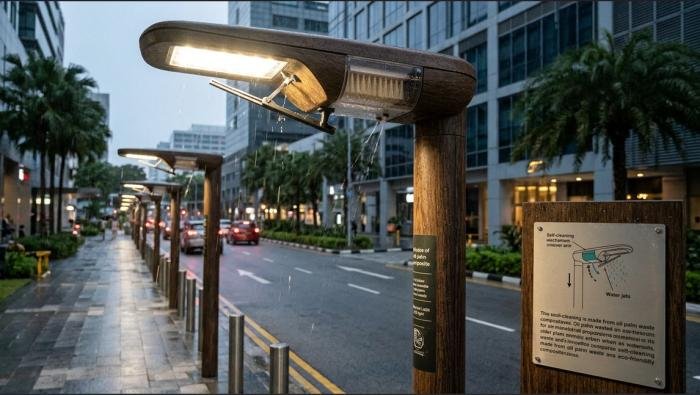
How Self-Cleaning Streetlights Using Oil Palm Waste Can Support Greener Cities
self cleaning streetlight oil palm waste, public security, and everyday transportation. However, traditional street lighting can consume considerable electricity and require regular maintenance. Dust, rain residue, insects, and pollution can gradually reduce the performance of lighting fixtures, especially in tropical and agricultural regions.
At the same time, oil palm processing generates large quantities of agricultural residues. Instead of allowing these materials to go unused, communities and energy developers can investigate ways to turn them into useful products and renewable energy. The concept of self cleaning streetlight oil palm waste brings these two challenges together. It considers how automatic cleaning technology and the responsible use of oil palm residues could contribute to more sustainable street lighting.
It is important to distinguish the concept from an established commercial product. Combining self-cleaning mechanisms with energy derived from oil palm waste is a potential engineering approach, not proof that every such system is already available or commercially successful. Understanding how the components could work together helps engineers, researchers, and local authorities assess its practical value.
What Is a Self-Cleaning Streetlight?
A self-cleaning streetlight is a lighting system designed to reduce the need for manual cleaning. It may use mechanical wipers, protective coatings, controlled airflow, vibration, or other cleaning methods to remove dust and surface contamination. The purpose is straightforward: keep the light source, protective cover, and relevant solar panels clean enough to maintain effective performance.
Read More: Contact Address Imagineergames: Address, Support & Contact Methods
How Automatic Cleaning Technology Works
A self-cleaning mechanism can operate at scheduled intervals or respond to environmental conditions. For example, a small motor might move a wiper across a transparent lamp cover. Another design might use a suitable coating that helps water carry away dirt. Sensors can monitor operating conditions, while a controller determines when cleaning should occur.
However, sensors are not necessary for every design, and no cleaning mechanism can eliminate all maintenance. In a proposed self cleaning streetlight oil palm waste system, the cleaning mechanism would need an appropriate power supply, reliable weather protection, and a design that does not interfere with the light distribution.
What Is Oil Palm Waste?
Oil palm waste consists of organic materials generated during palm cultivation and palm oil processing. These residues can have value when managed safely and efficiently. Common examples include empty fruit bunches, palm kernel shells, mesocarp fibres, and other processing residues. Their physical properties and energy potential differ, so they cannot all be used in the same way.
Common Types of Oil Palm Waste
Empty fruit bunches are fibrous materials left after fruit removal. Palm kernel shells are hard residues from kernel processing, while palm fibres can be separated during oil extraction. Depending on local processing methods, these materials may be used for composting, mulching, industrial heat, or biomass energy production. Some applications require drying, size reduction, or other processing before use.
Turning Agricultural Residues Into Useful Resources
Using residues productively can support a circular economy, where materials are reused rather than treated as unwanted waste. However, collection and transport also consume resources.
A well-designed self cleaning streetlight oil palm waste project should evaluate whether nearby processing facilities can provide a reliable supply of suitable residues. It should also consider existing uses for those materials, since diverting residues from productive applications may create unintended environmental or economic costs.
How Self-Cleaning Streetlights Can Use Oil Palm Waste
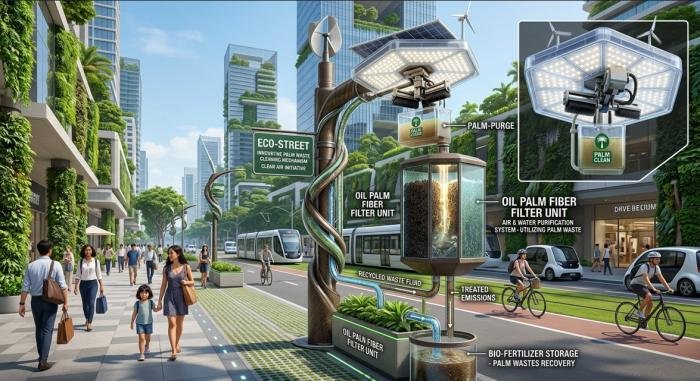
The concept combines two related but technically distinct functions: keeping lighting equipment clean and supplying electricity from a suitable energy source.
Biomass Energy for Street Lighting
Oil palm residues can be converted into usable energy through technologies such as combustion in an appropriate boiler, gasification, or anaerobic digestion of suitable organic materials. The most suitable process depends on the feedstock and the project’s energy requirements. For example, a biomass facility could generate electricity and feed it into a local distribution network. Streetlights could then use that electricity through a conventional electrical connection.
A smaller installation might use a suitable biomass conversion unit, but producing reliable electricity at a small scale requires careful engineering. Fuel preparation, emissions control, conversion efficiency, and equipment maintenance all affect feasibility. Biomass is not automatically carbon-neutral. Its environmental impact depends on how the feedstock is sourced, processed, transported, and converted.
Integrating Solar Power and Smart Controls
Solar-powered streetlights are another option for areas where grid access is limited. They typically use photovoltaic panels, batteries, LED lamps, and a charge controller. A hybrid design could use solar power for routine lighting and a biomass-based electricity supply for a larger local network or backup arrangement.
Such integration should be justified by energy demand, available sunlight, reliability requirements, and lifecycle costs. The self cleaning streetlight oil palm waste concept could therefore be developed in several configurations rather than relying on one universal design.
Separating the Energy and Cleaning Functions
A useful engineering principle is to separate the energy source from the cleaning mechanism. The biomass system could generate electricity, while a low-power motor or other mechanism cleans the lamp cover. Alternatively, a solar-powered streetlight could operate its cleaning mechanism from the same battery that supplies the LED lamp.
This separation makes it easier to test each component and identify faults. It also avoids assuming that oil palm waste must physically form part of the lamp or its cleaning mechanism. A practical design would prioritize dependable lighting, safe electrical components, and minimal additional energy consumption.
Major Environmental and Economic Benefits
A properly designed project may provide environmental and operational advantages, although results must be measured rather than assumed.
Reducing Agricultural Waste: Using suitable oil palm residues can reduce the amount of material requiring disposal and create additional value for agricultural by-products. Local biomass projects may also support jobs in collection, processing, transportation, and equipment maintenance.
Nevertheless, residues should be managed responsibly. Removing too much organic material from plantations can affect soil health, and poorly controlled biomass combustion can produce harmful air pollutants.
Improving Energy Efficiency: LED streetlights generally use less electricity than older lighting technologies that provide comparable illumination. Smart controls can further reduce consumption by adjusting light output according to time, occupancy, or traffic conditions when appropriate.
A self cleaning streetlight oil palm waste installation could combine efficient LED lighting with renewable electricity and automatic maintenance features. However, the cleaning system itself should consume as little energy as reasonably possible.
Potential Maintenance Savings: Cleaning lamps and solar panels manually can require staff, vehicles, equipment, and road access arrangements. Automatic cleaning could reduce some of these tasks, particularly in dusty or difficult-to-access locations.
Savings are not guaranteed. Motors, wipers, sensors, protective coatings, and control systems may introduce new maintenance requirements. A full cost analysis should compare the frequency and cost of manual cleaning against the installation, operation, and repair costs of the automatic mechanism.
Applications in Cities and Rural Communities
Sustainable street lighting can serve different purposes depending on the local environment. The most suitable system depends on available energy sources, road conditions, maintenance resources, and community priorities. In urban areas, LED streetlights with smart controls can reduce electricity consumption and improve lighting management.
Automatic cleaning may be useful near construction sites, industrial facilities, or busy roads where dust accumulates quickly. In rural communities near palm oil processing facilities, biomass energy may be worth evaluating because agricultural residues are generated locally. A self cleaning streetlight oil palm waste project could connect local waste management with public infrastructure.
Provided the fuel supply and energy conversion system are economically viable. The approach may also interest universities, municipal authorities, renewable energy developers, and agricultural cooperatives. A pilot project can help determine whether the concept works under local conditions before a larger investment is made.
Challenges and Practical Considerations
Although the idea has potential, successful implementation requires more than combining a streetlight with agricultural waste. Engineers must evaluate the complete system, including its energy supply, environmental impact, safety, and maintenance needs.
Biomass Processing and Energy Supply
Oil palm residues vary in moisture content, composition, and energy value. Wet materials may require drying, and transporting bulky residues can increase operating costs. Biomass conversion equipment also needs appropriate operating controls and emissions management. Electricity production must match the streetlight network’s demand, including nighttime operation and periods of reduced fuel availability.
A feasibility study for a self cleaning streetlight oil palm waste installation should examine local feedstock availability, energy conversion efficiency, storage requirements, and the cost of supplying electricity over the system’s expected lifespan.
Weather, Dust, and Cleaning Mechanisms
Streetlights face rain, humidity, heat, insects, airborne particles, and sometimes corrosive coastal conditions. Cleaning equipment must withstand these conditions without damaging lenses or electrical enclosures. In tropical climates, moisture and humidity can also affect electronic components and battery performance. Seals, drainage, corrosion-resistant materials, and suitable enclosure ratings are therefore important.
The automatic cleaning mechanism should be tested under realistic conditions. A self cleaning streetlight oil palm waste prototype should demonstrate that its cleaning function improves performance without excessive energy consumption or frequent mechanical failures.
Installation Costs and Safety
Installation costs can include LED fixtures, poles, batteries, control equipment, cleaning mechanisms, electrical protection, and the energy supply infrastructure. Biomass generation may require additional equipment for fuel handling, conversion, and pollution control. Streetlights must also comply with applicable electrical, structural, road-safety, and environmental requirements.
Any moving mechanism should be designed to prevent injury and remain secure during storms. Before expanding a self cleaning streetlight oil palm waste project, decision-makers should compare its total lifecycle cost with established alternatives. Purchasing the lowest-cost equipment does not always produce the lowest long-term operating cost.
Comparison of Sustainable Streetlight Approaches
| Streetlight approach | Main advantage | Main limitation | Suitable application |
| Grid-connected LED | Reliable electricity where the grid is stable | Depends on grid supply | Urban roads and public spaces |
| Solar LED streetlight | Independent operation with suitable battery storage | Weather and battery performance affect operation | Rural roads and remote locations |
| Biomass-supported lighting | Can use locally available agricultural residues | Requires fuel processing and energy conversion | Areas near suitable biomass resources |
| Automatic self-cleaning streetlight | Can reduce some manual cleaning tasks | Adds mechanical complexity | Dusty or difficult-to-access locations |
| Hybrid sustainable lighting | Can combine complementary energy sources | More components and controls to manage | Sites requiring additional energy resilience |
How to Implement an Oil Palm Waste Streetlight Project
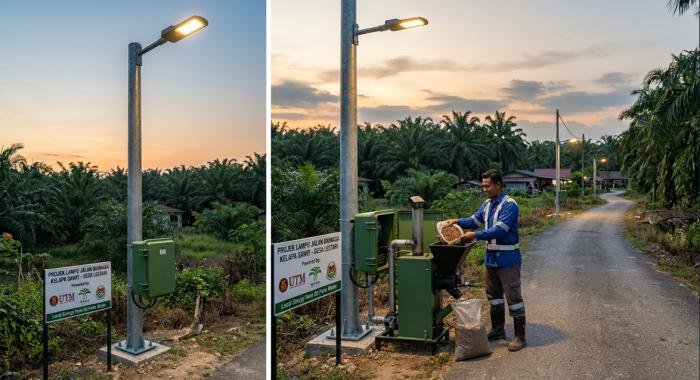
A practical project should progress through clear stages rather than moving directly from an idea to large-scale installation.
Step 1: Assess the location. Identify lighting needs, road conditions, dust exposure, electricity access, and the number of lamps required.
Step 2: Evaluate available residues. Determine the types, quantities, moisture levels, seasonal availability, and existing uses of locally available oil palm waste.
Step 3: Select the energy system. Compare grid electricity, solar power, biomass-generated electricity, and suitable hybrid configurations. Assess the cost and reliability of each option.
Step 4: Design the cleaning mechanism. Choose a mechanism appropriate for the lamp’s shape, environmental exposure, and maintenance requirements. Measure its power consumption and cleaning effectiveness.
Step 5: Build and test a prototype. A self cleaning streetlight oil palm waste prototype should be evaluated for brightness, energy consumption, weather resistance, cleaning performance, safety, and reliability.
Step 6: Measure results. Track maintenance visits, electricity use, equipment failures, operating costs, and environmental performance. Compare these measurements with a conventional streetlight baseline.
Step 7: Expand only when justified. If testing shows reliable operation and a reasonable lifecycle cost, consider a larger pilot with clear maintenance procedures and responsible waste sourcing.
The Future of Sustainable Street Lighting
Street lighting is becoming more efficient through LED technology, remote monitoring, adaptive controls, and improved power management. At the same time, agricultural waste can provide useful raw materials and energy when suitable conversion technologies are available.
The self cleaning streetlight oil palm waste concept reflects an opportunity to connect these developments. It could be especially relevant in regions where palm oil processing and public infrastructure are both important parts of the local economy.
Future research should focus on practical questions: How much energy does the cleaning mechanism require? Which biomass conversion method is most suitable? How does the system perform during heavy rain and high humidity? Can its lifecycle costs compete with conventional lighting?
Answering these questions through field trials and transparent measurements will be more valuable than relying on promotional claims. With sound engineering and responsible resource management, the concept may contribute to cleaner, more efficient public lighting.
Final Thoughts
Sustainable street lighting offers an opportunity to improve public infrastructure while making better use of available resources. Combining efficient LED lamps, suitable automatic cleaning mechanisms, and responsibly sourced renewable energy could help address electricity consumption, maintenance demands, and agricultural waste management. The self cleaning streetlight oil palm waste concept is particularly interesting for regions where palm oil processing produces significant quantities of agricultural residues.
However, its success depends on practical engineering, reliable energy conversion, environmental safeguards, and a clear economic case. Rather than assuming that the technology will automatically reduce costs or emissions, developers should begin with a small prototype, measure its performance, and compare the results with existing streetlight systems.
Evidence-based development can help identify where the approach works best and where other technologies may be more suitable. Ultimately, self cleaning streetlight oil palm waste represents a promising direction for research into smarter and more sustainable public lighting. With careful planning, transparent testing, and responsible resource management, it could contribute to more efficient infrastructure and a more circular use of agricultural materials.
FAQs
Q1: What is a self-cleaning streetlight?
Ans: A self-cleaning streetlight uses a mechanism such as a motorized wiper, protective coating, or controlled airflow to reduce dirt accumulation. It can reduce manual cleaning needs, although periodic inspection and maintenance are still necessary.
Q2: How can oil palm waste be used for street lighting?
Ans: Oil palm residues, including palm kernel shells and suitable fibres, can be processed to generate energy. That energy may supply electricity to streetlights through an appropriately designed biomass power system. The suitability depends on the fuel, conversion technology, and local conditions.
Q3: What are the main benefits of self cleaning streetlight oil palm waste technology?
Ans: Potential benefits include productive use of agricultural residues, renewable electricity generation, reduced manual cleaning requirements, and more efficient street lighting. Actual results depend on system design, fuel sourcing, maintenance costs, and operating conditions.
Q4: Can oil palm waste directly power an LED streetlight?
Ans: Not without an appropriate energy conversion system. Oil palm waste must first be converted into a usable energy form, such as electricity from a biomass generator. The electricity can then power LED streetlights directly or through a suitable distribution and storage system.
Q5: Is self cleaning streetlight oil palm waste technology environmentally friendly?
Ans: It can offer environmental benefits when agricultural residues are responsibly sourced, biomass emissions are controlled, and energy conversion is efficient. Its overall impact should be evaluated using lifecycle analysis, including transportation, processing, equipment manufacture, and operation.






2 Comments