
Tesla Tiny House: Smart Design, Solar Power & Modern Living
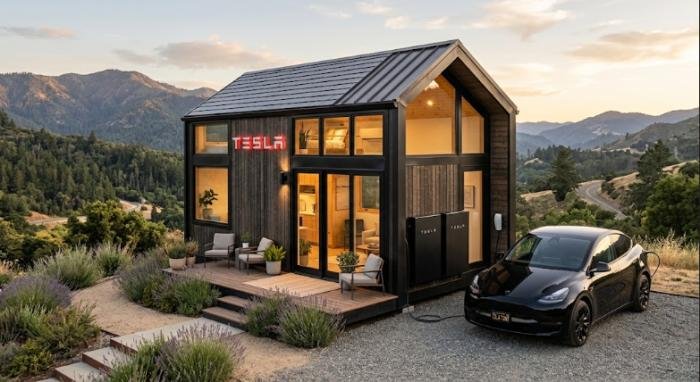
The Tesla tiny house has become one of the most talked-about concepts at the intersection of tiny-home living, renewable energy, battery storage, and electric transportation. Images of a compact house carrying the Tesla name have also fueled online claims that Tesla has launched an inexpensive home for consumers.The reality is more interesting—and more useful to understand. Tesla did create and tour a small solar-powered house in Australia in 2017.
However, it was a demonstration model designed to showcase Tesla’s solar and energy-storage technology, not a residential house that customers could purchase. PolitiFact confirmed that Tesla did not sell that house or similar houses as a consumer housing product.That distinction matters because many websites and social-media posts have since presented concept images, unrelated tiny homes, or AI-generated pictures as if they were official Tesla products.
At the same time, the technology demonstrated by the original house remains relevant. Tesla currently offers residential energy products such as solar systems and Powerwall battery storage, making it possible to discuss what a Tesla-inspired tiny home could realistically look like today.
Read More: Online Safety Tips for Safer Browsing & Online Privacy
What Is the Tesla Tiny House?
The original Tesla Tiny House was a compact, mobile demonstration structure created to promote Tesla’s vision for residential solar energy and battery storage. In 2017, Tesla toured the house around Australia. The structure was designed to demonstrate how electricity generated by solar panels could be stored in a Powerwall battery and then used in the home. Contemporary reporting described the house as approximately 20 feet long and just over 7 feet wide, with a 2-kilowatt solar system and a Powerwall. It was also towed between locations by a Tesla Model X.
Was the Tesla Tiny House Ever Sold?
This is the first fact readers should understand before considering price, specifications, or purchasing options.PolitiFact investigated claims that Elon Musk was launching inexpensive Tesla homes and found no evidence supporting those claims. Its fact-check states that the 2017 Tesla Tiny House was a model used to showcase Tesla’s solar technology and that Tesla never sold that house or similar houses.
Therefore, articles claiming that consumers can order the original Tesla Tiny House directly from Tesla should be treated with caution. There is also no reliable basis for treating viral claims about a new $5,000, $10,000, or $12,000 Tesla home as an official Tesla product announcement.
Why Does the Concept Still Matter?
Although the original structure was a marketing and technology demonstration, its underlying concept remains relevant. The house brought together several ideas that have become increasingly important in modern residential design:
- Small and efficient living spaces
- Solar electricity
- Battery energy storage
- Electric transportation
- Digital energy monitoring
- Reduced dependence on conventional energy sources
- Integration between transportation and home energy
Tesla Tiny House Design: What Made It Different?
The original demonstration house was deliberately compact. Contemporary reporting described it as roughly 20 feet long, slightly more than 7 feet wide and about 13 feet high. It weighed around 2.2 tons and was designed to be transported during the Australian tour. Its design demonstrated how a relatively small structure could function as a showcase for renewable energy technology.
Compact Living
A tiny house has an obvious advantage: it requires less physical space than a conventional home. That can potentially mean less material, lower heating and cooling requirements, and fewer resources required to operate the building. However, small size alone does not automatically make a home sustainable. A poorly insulated tiny house with inefficient appliances can still consume considerable energy. Good design therefore matters as much as square footage.
A practical compact home should consider:
- Insulation
- Windows
- Natural ventilation
- Efficient lighting
- Heating and cooling
- Appliance efficiency
- Water heating
- Storage
- Solar orientation
- Available roof area
Solar-Powered Design
The original Tesla demonstration placed solar generation at the center of the concept.Contemporary reports described a 2-kilowatt solar installation connected with a Powerwall battery. The principle is straightforward. Solar panels generate electricity when sunlight is available. Instead of using all generated electricity immediately, excess energy can be stored in a battery and used later.
That is particularly useful for a small home because many household activities occur after sunset, when solar panels are no longer producing electricity.
How Tesla Solar Technology Could Power a Tiny House
A modern Tesla-inspired tiny house would not need to copy the 2017 structure exactly. Instead, it could use currently available Tesla energy technology where the products, electrical configuration, building design, and local regulations permit.
Tesla Solar Panels
Tesla’s residential solar systems are designed to generate electricity from sunlight for household use. Solar generation can be combined with battery storage so that excess electricity can be retained for later use. For a tiny house, the available roof area becomes an important consideration.
A small roof cannot necessarily accommodate as many panels as a conventional home. Roof orientation, shading, local sunlight conditions and the home’s electricity consumption all influence the appropriate solar-system size.
Powerwall Battery Storage
Powerwall is Tesla’s residential battery-storage system. Tesla’s current Powerwall 3 documentation lists a nominal energy capacity of 13.5 kWh and up to 11.5 kW of continuous on-grid power, depending on configuration. Tesla also lists a 10-year warranty for Powerwall 3. The distinction between energy capacity and power output is important.
Energy capacity describes how much electricity the battery can store. Power output describes how quickly it can deliver electricity.
How Solar and Powerwall Work Together
A simplified daily cycle could look like this:
- Solar panels generate electricity during daylight.
- The home uses electricity as needed.
- Excess solar production charges the battery.
- The battery supplies electricity when solar production falls.
- The grid can provide additional electricity when required, depending on the installation.
- During an outage, Powerwall can provide backup power when properly installed and configured.
Tesla Tiny House Smart-Home Features
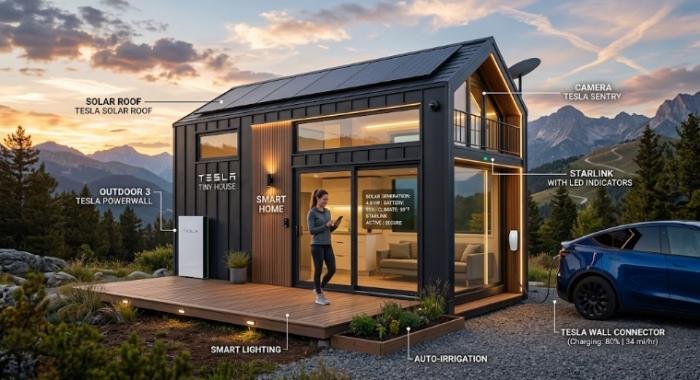
The original demonstration was not simply a small building with solar panels on the roof. It was intended to show how energy could be generated, stored and managed as a connected system.
Energy Monitoring
Digital monitoring allows homeowners to see how much electricity a system is generating, storing and consuming. That information can make energy use more understandable and can help homeowners identify unusually high consumption. For a tiny home, this can be especially useful because a few appliances may represent a large percentage of total electricity demand.
Automated Energy Management
Modern home-energy systems can make decisions about when electricity should be stored, consumed or supplied from different sources. For example, stored energy may be valuable during an evening period when solar generation has stopped. In regions with time-based electricity pricing, battery-management strategies can also affect household energy costs.
Electric Vehicle Integration
The Tesla Tiny House concept also highlighted an interesting relationship between an electric vehicle and a solar-powered home. An EV can potentially be charged using electricity generated by a home’s solar system. Tesla’s current Powerwall materials also describe the ability to optimize stored energy for EV charging in supported configurations. This creates a broader concept: Solar generation → home energy → battery storage → electric transportation
Tesla Tiny House and Sustainable Living
Small homes and renewable energy are often discussed together, but sustainability requires more than installing solar panels.
Smaller Homes Can Reduce Resource Requirements
A smaller building generally requires less physical material than a larger one, although the actual environmental impact depends on construction methods, materials, transportation, durability and how efficiently the home is operated. A thoughtfully designed tiny house can reduce unnecessary space and encourage people to focus on the functions they actually need.
Solar Electricity Can Reduce Conventional Grid Demand
Solar panels generate electricity without directly burning fossil fuels at the point of generation. However, a solar home does not automatically become completely independent of the electricity grid. Solar production changes throughout the day and year, while household electricity demand also changes. Battery storage helps bridge that mismatch.
Battery Storage Makes Solar More Flexible
Solar electricity is easiest to use when it is being generated. A battery provides a way to shift some of that electricity to a later period. Tesla explains that Powerwall stores electricity for use when needed and can provide backup power during grid interruptions. For tiny-home owners, that flexibility could be valuable, particularly when the building has carefully managed energy consumption.
How Much Does a Tesla Tiny House Cost?
There is no official current Tesla Tiny House retail price because Tesla does not currently sell the 2017 demonstration house as a standard residential product. This is an important distinction when evaluating online price claims.
Why There Is No Official Tesla Tiny House Price
Tesla’s current residential energy offerings include technologies such as Powerwall and solar systems rather than a consumer tiny-house product. Independent fact-checking has also found no evidence that Tesla launched the widely circulated low-cost homes claimed on social media. Consequently, it would be misleading to give readers a made-up “Tesla Tiny House price.” A Tesla-inspired tiny house is a different matter. Its total cost could include:
- The tiny-house structure
- Land
- Foundation or site preparation
- Solar equipment
- Battery storage
- Electrical equipment
- Plumbing
- Heating and cooling
- Appliances
- Interior finishes
- Transportation
- Installation
- Permits
- Local taxes and fees
The cost of the energy system can therefore be only one part of the overall project.
Why Viral $5,000–$12,000 Claims Should Be Questioned
Social-media posts have repeatedly claimed that Elon Musk or Tesla is launching extremely inexpensive homes. PolitiFact investigated claims about a $12,000 Tesla house and found no supporting evidence. Its review concluded that the 2017 Tesla Tiny House was a demonstration model rather than a commercial home.
Tesla Tiny House vs. Traditional Tiny Home
| Feature | Tesla Tiny House Concept | Conventional Tiny Home |
| Commercial Tesla house product | Not currently offered | Available from various builders |
| Solar integration | Central to the original demonstration | Depends on the builder |
| Battery storage | Demonstrated with Tesla Powerwall | Depends on the chosen system |
| Smart energy monitoring | Part of the Tesla energy concept | Varies by equipment |
| EV ecosystem | Strong Tesla-related potential | Depends on charging setup |
| Purchase price | No official Tesla house price | Varies by size, materials and builder |
| Availability | Demonstration concept rather than a standard product | Commercially available in many markets |
| Customization | Not applicable as a consumer Tesla product | Usually depends on builder |
Tesla Tiny House vs. RV: Which Is Better?
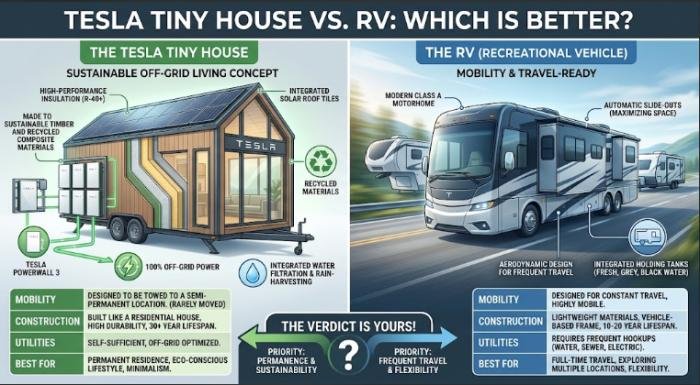
A tiny house and an RV may appear similar because both can be compact and mobile, but they serve different purposes.
Tiny House Advantages
A tiny home can be designed around residential living rather than recreational travel. That may provide more flexibility for:
- Permanent living
- Larger kitchen layouts
- Dedicated work areas
- Residential appliances
- Long-term storage
- Custom interior design
The exact legal classification, however, depends on local regulations.
RV Advantages
RVs are specifically designed around mobility. For someone who wants to travel frequently, an RV may make more sense than a tiny house. It may also operate under a different regulatory framework. The decision should therefore be based on intended use rather than appearance.
Can You Build a Tesla-Inspired Tiny House Today?
Yes, a homeowner can design a small home around solar generation and battery storage. That does not make the resulting structure an official Tesla house. The distinction is important for accurate marketing and consumer protection.
Using Tesla Solar Panels and Powerwall
Tesla’s current energy products can form part of a residential solar-and-storage system. Tesla documentation describes Powerwall as a battery system that can work with solar generation and provide backup power. Whether a particular tiny house is suitable depends on its electrical design, location, roof structure, solar exposure, energy requirements and applicable installation rules.
What Should Be Planned Before Construction?
A serious project should begin with an energy assessment.
Consider:
- Daily electricity consumption
- Heating and cooling requirements
- Water heating
- Cooking
- Refrigeration
- Lighting
- Electronics
- Laundry
- EV charging
- Solar production
- Battery capacity
- Backup requirements
This approach is more reliable than choosing a battery first and designing the home around a marketing specification.
Professional Installation Is Important
Battery storage and solar systems involve high electrical power and must be installed according to applicable technical and safety requirements. Tesla provides dedicated system-design and installation documentation for Powerwall. Its technical documentation also specifies system limits, electrical requirements and installation conditions. Local building, electrical, zoning and utility requirements should also be checked before construction.
Benefits of a Tesla-Inspired Tiny House
A thoughtfully designed Tesla-inspired home could offer several advantages.
Potential Energy Efficiency: A small, well-insulated building can reduce the amount of energy required for heating and cooling compared with a much larger home.
Solar Generation: Solar panels can generate electricity on-site and reduce reliance on purchased electricity when conditions allow.
Battery Backup: Powerwall can provide backup power during outages in supported installations. Tesla currently lists 13.5 kWh of energy capacity and up to 11.5 kW of continuous power for Powerwall 3.
Energy Visibility: Digital monitoring can help residents understand how much electricity they are generating and consuming.
Smaller Physical Footprint:
A compact home can encourage efficient use of space and potentially reduce material requirements.
Challenges and Limitations
The technology is attractive, but a realistic assessment should include the drawbacks.
It Is Not a Tesla Housing Product
The biggest limitation is simple: the original Tesla Tiny House is not a current Tesla residential product. Anyone selling a “brand-new official Tesla Tiny House” should therefore be able to provide verifiable evidence from Tesla.
Limited Roof Space
Tiny homes have less roof area for solar panels. This can restrict the amount of electricity the solar system can generate, especially when the home has high electrical demand.
Energy Demand Can Still Be High
A small home can contain energy-intensive equipment. Air conditioning, electric heating, water heating, cooking and EV charging can consume considerably more electricity than lighting and electronics.
Battery Storage Has Physical and Financial Requirements
Powerwall is compact relative to many conventional battery systems, but it still requires appropriate installation space, electrical infrastructure and professional planning.
Building Regulations Matter
Tiny-home legality varies by jurisdiction. Before buying land or constructing a home, owners should investigate:
- Zoning
- Building codes
- Minimum dwelling sizes
- Foundation requirements
- Utility connections
- Electrical rules
- Plumbing requirements
- Road and transport regulations
A technically impressive tiny home can still be impractical if it cannot legally be placed where the owner intends to live.
Tesla Tiny House Myths and Facts
Myth: Tesla Sells a $12,000 Tiny House
Fact: There is no reliable evidence that Tesla sells an official $12,000 residential tiny house. PolitiFact specifically investigated this claim and found it unsupported.
Myth: The 2017 Tesla Tiny House Was a Normal Home for Customers
Fact: It was a demonstration model created to showcase Tesla’s solar and energy-storage technology.
Myth: Solar Panels Automatically Make a Tiny House Off-Grid
Fact: Solar generation depends on sunlight and system capacity. A truly off-grid home needs enough generation, storage and energy-management capability to meet its requirements across changing conditions.
Myth: Every Tesla Tiny House Image Online Is Official
Fact: Images can represent old demonstrations, concepts, unrelated buildings or digitally generated designs. Verification through Tesla’s official channels is important.
Final Verdict: What the Tesla Tiny House Really Represents
The Tesla Tiny House is best understood as a demonstration of an energy concept rather than a Tesla home that consumers can currently order. The 2017 Australian demonstration showed how a compact structure could combine solar generation and Powerwall storage in a highly visible example of renewable residential energy. Contemporary reports documented its solar system, compact dimensions and use as part of Tesla’s Australian energy roadshow.
Today, the more realistic interpretation is a Tesla-inspired tiny home equipped with appropriate residential energy technology. Tesla’s current Powerwall products demonstrate that battery storage, solar generation and backup power remain important parts of the company’s energy ecosystem.
For prospective homeowners, the most important lesson is to separate verified technology from internet speculation. There is no need to rely on viral claims about a mythical low-cost Tesla house. A practical project starts with the building itself, local regulations, energy consumption, solar potential, battery requirements and total ownership costs. The appeal of the concept ultimately goes beyond Tesla.
FAQs about tesla tiny house
Q1: Is the Tesla Tiny House real?
Ans: Yes, Tesla created a real Tiny House demonstration model in 2017 and toured it in Australia. However, it was designed to showcase Tesla’s solar and battery technology rather than serve as a commercially available Tesla home.
Q2: Can you buy a Tesla Tiny House from Tesla?
Ans: No current Tesla consumer housing product matches the original demonstration house. Tesla’s residential energy business focuses on products such as solar systems and Powerwall rather than selling a standard Tesla tiny house.
Q3: How much does the Tesla Tiny House cost?
Ans: There is no official current retail price because Tesla does not sell the original Tiny House as a standard residential product. Online prices claiming that Tesla offers a $5,000 or $12,000 house should not be treated as verified Tesla pricing.
Q4: Did Tesla release a $12,000 house?
Ans: There is no reliable evidence that Tesla released a $12,000 home. PolitiFact investigated the claim and found it false, noting that the 2017 Tesla Tiny House was a demonstration model rather than a home offered for sale.
Q5: Can Powerwall power a tiny house?
Ans: Powerwall can provide stored electricity and backup power for a properly designed residential electrical system. Powerwall 3 has a nominal 13.5 kWh capacity and can provide up to 11.5 kW of continuous power in supported configurations. Whether one unit is appropriate for a particular tiny home depends on the home’s electrical loads and system design.
Q6: Can Tesla Solar Panels be used on a tiny house?
Ans: Tesla solar technology can be used in residential energy systems, but suitability for a specific tiny home depends on factors such as roof area, structure, electrical design, location, shading and installation requirements. A qualified installer should assess the property before installation.
Q7: Can a tiny house run completely on solar power?
Ans: It can be possible when the solar system, battery storage and household energy demand are appropriately matched, but solar generation varies with weather, season and available sunlight. A grid-connected system with battery backup is different from a genuinely off-grid system.