
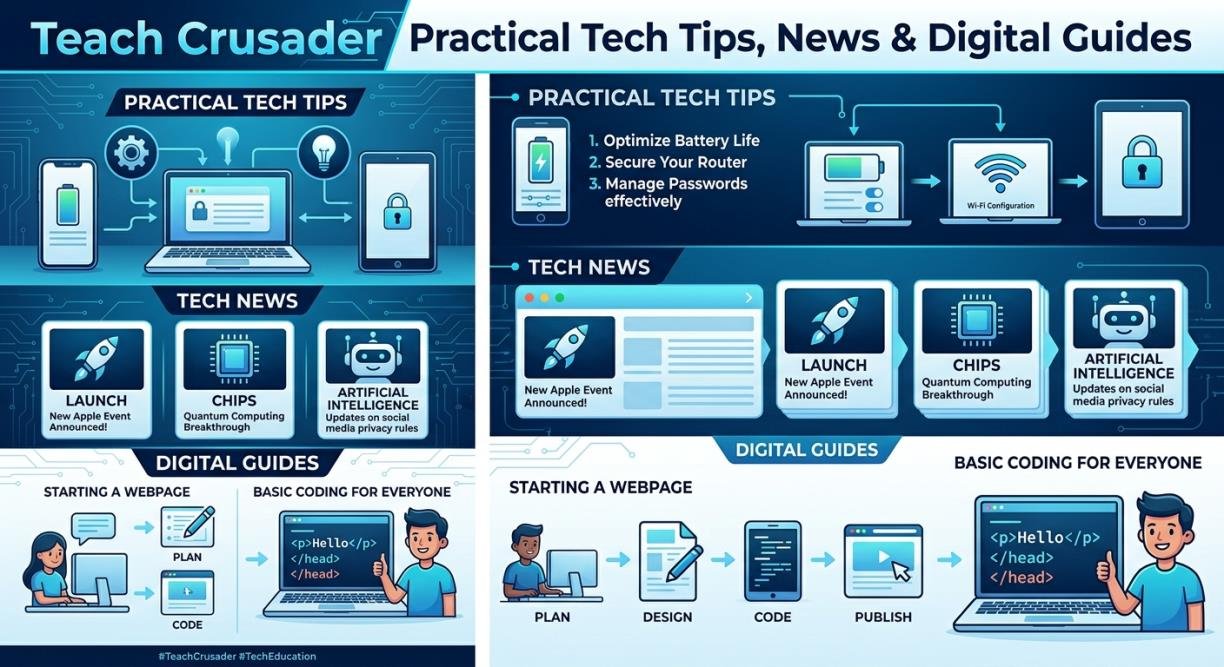
Teach Crusader: Practical Tech Tips, News & Digital Guides
Technology is everywhere, but understanding it is not always easy. From confusing software updates and AI tools to online scams, privacy risks, and endless gadget choices, people often struggle to know what information they can trust or what action to take. Teach Crusader addresses this problem by turning complex technology topics into clear, practical, and easy-to-follow guidance.
It covers technology tips, digital news, AI, apps, gadgets, cybersecurity, privacy, and step-by-step tutorials designed for everyday users. The purpose is simple: to help readers understand technology, solve digital problems, stay safer online, and make smarter technology decisions with confidence.
Read more: Block Breaker Google: Play the Classic Arcade Game Online & Beat the High Score
What Is Teach Crusader?
Teach Crusader can serve as a technology-focused content destination covering practical technology tips, digital news, software, applications, artificial intelligence, gadgets, cybersecurity, privacy, and step-by-step digital guides. The most useful technology content does more than repeat specifications or summarize announcements.
It explains what a technology change means for an ordinary user and, when possible, shows how to apply that information. For example, a basic article might announce that an application has received a new feature. A more useful guide would explain:
- What changed
- Who can use the feature
- Where to find it
- How it works
- What limitations apply
- Whether users should change an existing workflow
- What privacy or security considerations matter
What Does Teach Crusader Cover?
A technology publication can serve readers with very different levels of experience. Someone may need help fixing a slow computer, while another reader may want to evaluate an AI application or compare two smartphones.A broad but focused technology resource can address these needs through several categories.
Technology Tips and Tutorials
Practical tutorials can address common problems involving:
- Smartphones
- Computers
- Browsers
- Applications
- Internet connections
- File management
- Cloud storage
- Productivity tools
Digital News
Technology news can cover significant developments in:
- Artificial intelligence
- Smartphones
- Computers
- Software
- Cybersecurity
- Cloud computing
- Digital platforms
- Consumer electronics
AI and Emerging Technology
Artificial intelligence has become one of the most important areas of technology coverage. Useful AI content can discuss practical applications, limitations, privacy considerations, accuracy, and responsible use.
Apps and Software
Software guides can help readers choose and use:
- Productivity applications
- Browsers
- Cloud services
- Communication tools
- Security software
- Note-taking applications
- File-management utilities
Gadgets and Consumer Technology
Technology readers often need practical advice before purchasing a smartphone, laptop, tablet, wearable, accessory, or smart-home device. A useful recommendation considers more than specifications. Compatibility, software support, warranty terms, total cost, user requirements, and real-world performance can matter just as much as processor speed or camera resolution.
Why Practical Technology Guides Matter
Technology can become confusing because products and software change quickly. A feature that worked one way last year may have a different interface today. Practical guides bridge the gap between technical information and everyday use.
Turning Technical Information Into Useful Advice
Consider a new security feature. Simply reporting that the feature exists gives readers information, but a practical guide can answer the questions they actually have:
- What does the feature do?
- Why does it matter?
- Who should use it?
- How is it activated?
- Does it have limitations?
- Does enabling it affect convenience or privacy?
Helping Readers Make Better Technology Decisions
Before purchasing or adopting a digital product, users should consider their actual needs.A student may prioritize battery life and portability. A video editor may care more about processing performance, memory, storage, and display quality. A business user may place greater importance on security, support, compatibility, and reliability. There is rarely a single technology product that is best for every person.
A Reliable Approach to Technology Information

Trust is particularly important in technology publishing because inaccurate advice can cause financial loss, security problems, or wasted time. Google describes E-E-A-T as experience, expertise, authoritativeness, and trustworthiness, while noting that trust is the most important aspect among them. Google also recommends making it clear who created content, how it was produced, and why it exists.
Use Primary Sources Whenever Possible
Strong sources can include:
- Official manufacturer documentation
- Developer documentation
- Government agencies
- Universities
- Standards organizations
- Original research
- Reputable publications
Separate Facts From Opinions
A technology article can contain analysis and recommendations, but readers should be able to tell the difference between a confirmed fact and an editorial judgment.
For example:
Fact: A manufacturer lists a particular specification.
Analysis: That specification may benefit users who perform demanding tasks.
Opinion: A writer may consider another product a better choice for a particular audience. Keeping these categories separate makes an article more transparent.
Show Who Created the Content
An E-E-A-T-friendly technology website should provide:
- Author names
- Author biographies
- Relevant experience
- Editorial standards
- Sources
- Update information when appropriate
Practical Tech Tips Every Digital User Should Know
Technology expertise begins with a few basic habits.
Keep Software Updated
Operating systems, browsers, applications, and other software frequently receive updates that fix bugs and security vulnerabilities. CISA advises users not to delay software updates because security flaws can provide opportunities for criminals to access devices, files, or accounts. Automatic updates can be useful when available, particularly for security-related updates.
Use Strong, Unique Passwords
Reusing one password across multiple accounts creates unnecessary risk. If one service is compromised, reused credentials may potentially expose other accounts. A password manager can help users generate and store unique passwords without requiring them to memorize every credential.
Enable Multifactor Authentication
Multifactor authentication, commonly called MFA, adds another verification method beyond a password. CISA recommends MFA because an additional authentication factor can make unauthorized account access more difficult even if a password has been compromised. Where supported, users should consider enabling MFA on important accounts such as email, financial services, cloud storage, and social platforms.
Protect Personal Information
Before granting an application access to contacts, location, photos, microphones, cameras, or other information, users should consider whether that permission is genuinely necessary. Privacy settings vary between operating systems and applications, so users should periodically review permissions instead of assuming that an old setting remains appropriate.
Back Up Important Data
Important photographs, documents, educational materials, business files, and other irreplaceable information should not exist in only one location. A backup strategy can involve cloud storage, external storage, or another independent copy. The exact approach depends on the user’s needs and the importance of the data.
Teach Crusader and Artificial Intelligence
AI deserves careful treatment because its capabilities and limitations can be misunderstood.
What Is Generative AI?
Generative AI refers to systems capable of producing content such as text, images, audio, video, or software code in response to user instructions.
Its usefulness depends heavily on the task, the quality of the input, the system being used, and the degree of human verification.
Common Uses of AI
People may use AI tools for:
- Drafting and editing
- Brainstorming
- Summarizing information
- Translation assistance
- Coding support
- Research assistance
- Image creation
- Data organization
- Productivity tasks
AI Accuracy Has Limits
An AI system can produce an answer that sounds convincing while containing factual errors. Therefore, important information should be verified against appropriate sources. For technical writing, verification can include checking official documentation. For academic subjects, university resources or original research may be more appropriate. For government matters, official government sources are generally preferable.
Responsible AI Use
Users should also consider privacy before entering confidential information into an AI service. Organizations may have their own policies concerning AI-generated material, particularly for business, education, intellectual property, and sensitive information. The safest general approach is to treat AI as a tool that supports human judgment rather than as an unquestionable authority.
Smartphone and Mobile Technology Tips
Smartphones contain personal communications, photographs, accounts, location information, and applications, making basic security particularly important.
Manage Applications Carefully
Install applications from reputable sources and pay attention to:
- Developer identity
- Requested permissions
- Privacy information
- Update history
- Reviews from multiple sources
- Pricing and subscription terms
Review Privacy Permissions
If an application requests access to information unrelated to its function, users should pause and consider whether the permission is justified. Mobile operating systems generally provide permission controls that allow users to review or modify access.
Computer and Laptop Guidance
Computers remain central to work, education, creativity, and business.
Improve Everyday Performance
When a computer becomes slow, users can begin with relatively simple checks:
- Available storage
- Pending system updates
- Unnecessary startup applications
- Browser extensions
- Resource-heavy programs
- Security software status
Know When to Seek Professional Help
Some problems require more advanced knowledge. Hardware failures, corrupted systems, suspicious malware activity, or important data-recovery situations can become worse if users attempt risky repairs without understanding the consequences. Official manufacturer support and qualified technicians are safer options for complex problems.
Digital Safety and Online Scams
Online scams increasingly rely on social engineering rather than purely technical attacks. A fraudulent message may attempt to create urgency, fear, curiosity, or financial pressure.
Recognizing Phishing
Phishing attempts commonly try to persuade users to:
- Click a suspicious link
- Open an unexpected attachment
- Reveal login information
- Send money
- Provide personal information
Evaluating Online Sellers
The Federal Trade Commission recommends researching sellers and products, comparing offers, reviewing delivery and refund policies, keeping purchase records, and considering what personal information a website or application collects. Reviews should also be treated critically. The FTC recommends checking multiple sources and considering who wrote a review, where it was posted, and the reviewer’s history.
What to Do After a Scam
If someone believes they have interacted with a scammer, they should act quickly. Depending on the situation, appropriate steps may include:
- Contacting the bank or payment provider
- Changing compromised passwords
- Enabling MFA
- Saving relevant messages and receipts
- Reporting the incident to the appropriate authority
- Monitoring affected accounts
How to Evaluate Technology Before Buying

Technology purchases should begin with the user’s requirements rather than marketing language.
| Evaluation Area | Questions to Ask | Why It Matters |
| Performance | Does it handle the tasks I actually perform? | Prevents paying for unnecessary performance |
| Compatibility | Does it work with my existing devices and software? | Avoids integration problems |
| Cost | What will I pay initially and over time? | Reveals subscriptions and additional expenses |
| Support | How long will updates and support be available? | Affects long-term usability |
| Security | What security features are provided? | Helps reduce avoidable risks |
| Reviews | Do multiple credible sources agree? | Reduces dependence on one opinion |
Specifications Are Not Everything
Specifications are useful, but they do not always predict the complete user experience. Battery capacity, for example, does not alone determine battery life. Software efficiency, display settings, processor workload, connectivity, and usage patterns can all influence real-world performance.
Consider Total Ownership Cost
A product’s advertised price may not represent its entire cost. Users may also need:
- Accessories
- Storage upgrades
- Software subscriptions
- Replacement parts
- Extended warranty coverage
- Cloud services
Use Multiple Review Sources
One review can be informative, but several independent sources provide a broader picture. The FTC recommends consulting trusted expert reviews and checking customer feedback across multiple sources rather than relying on one rating or review.
How Beginners Can Build Digital Skills
Start With Basic Skills
Beginners can first become comfortable with:
- Web browsing
- File management
- Software updates
- Password security
- Cloud storage
- Basic troubleshooting
Move Toward Productivity
Once the fundamentals are comfortable, users can develop skills involving:
- Digital calendars
- Note-taking applications
- Document collaboration
- Cloud-based workflows
- Automation
- AI-assisted productivity
Build Advanced Knowledge Gradually
More advanced subjects can include:
- Cybersecurity
- Cloud computing
- Data privacy
- Artificial intelligence
- Programming
- Automation
- Networking
How to Judge Reliable Technology Information
Not every technology article deserves equal trust.
Check the Author: Look for a visible author and information about their relevant experience.
Check the Sources: Strong articles should make important claims verifiable through appropriate sources.
Check the Publication Date: Technology changes quickly. A tutorial written several years ago may no longer describe the current interface or available features.
Watch for Warning Signs: Be cautious when an article:
- Makes extraordinary claims without evidence
- Uses excessive hype
- Hides limitations
- Has no identifiable author
- Provides no supporting sources
- Appears to copy material from other websites
Final Thoughts
Technology is changing faster than ever, yet finding clear, trustworthy, and practical advice can still be difficult. Confusing information, outdated guides, security risks, and overwhelming choices can leave everyday users unsure about what to do next. Teach Crusader aims to solve that problem by turning complex technology topics into simple, useful, and actionable guidance.
From AI and apps to cybersecurity, gadgets, troubleshooting, and digital safety, its purpose is to help readers understand technology and use it with greater confidence. That people-first approach—providing practical knowledge, reliable information, and meaningful solutions that help readers make smarter digital decisions every day.
Frequently Asked Questions
Q1: What is Teach Crusader?
Ans: Teach Crusader is presented as a technology-focused content concept centered on practical technology tips, digital news, AI, applications, gadgets, cybersecurity, privacy, and useful digital guides. Its strongest value comes from making technical subjects easier to apply in everyday situations.
Q2: What topics does Teach Crusader cover?
Ans: The content can cover technology tutorials, digital developments, artificial intelligence, smartphone and computer advice, applications, consumer gadgets, cybersecurity, privacy, productivity, and practical troubleshooting.
Q3: Is Teach Crusader suitable for beginners?
Ans: Yes. A beginner-friendly technology resource should explain unfamiliar terminology, provide step-by-step instructions, and avoid assuming advanced technical knowledge. More advanced subjects can then be introduced gradually.
Q4: Can Teach Crusader help with everyday technology problems?
Ans: Practical technology guides can help with common issues involving devices, applications, browsers, storage, software updates, account security, and digital productivity. For serious hardware failures or complex security incidents, users should consider official support or qualified professional assistance.
Q5: Does Teach Crusader cover artificial intelligence?
Ans: AI can be an important part of technology coverage, including practical applications, productivity, limitations, privacy, and responsible use. AI-generated information should be checked when accuracy matters.
Q6: How can I tell whether technology advice online is reliable?
Ans: Check who wrote the content, when it was published or updated, which sources support its claims, whether the author demonstrates relevant expertise, and whether independent authoritative sources agree. Google recommends clear authorship, original value, appropriate expertise, and trustworthy information.