Pulsamento: Meaning, Rhythm, Uses, and Its Role in Music and Daily Life
Pulsamento is a concept associated with rhythm, pulse, and the natural flow of movement in music and everyday life. From the steady beat of a song to the repeated movements people make throughout the day, rhythmic patterns influence how we experience sound, motion, and timing. In music, pulsamento can help describe the connection between a regular beat and the expressive patterns that bring a performance to life.
Understanding its relationship with rhythm provides a useful way to appreciate how music creates energy, supports coordination, and communicates emotion across different musical styles.
What Does Pulsamento Mean?
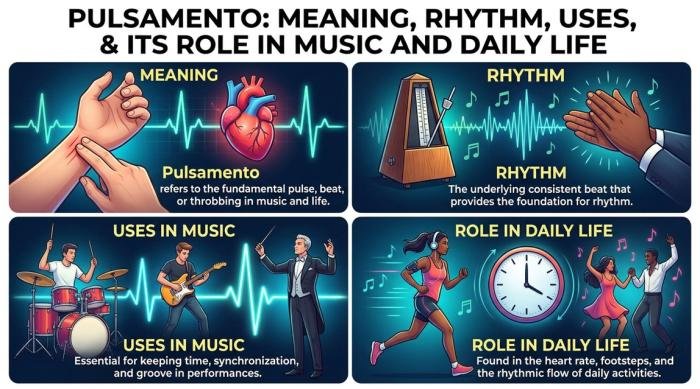
The word pulsamento is associated with the idea of pulsing or producing a repeated rhythmic movement. Its interpretation can depend on the context in which it appears. In discussions of music, it may refer to a pulse, a recurring beat, or a rhythmic approach that helps organize musical sounds.
A musical pulse is the regular underlying beat that listeners can often tap their feet or clap their hands to while hearing a song. It provides a sense of timing, even when the melody or percussion follows more complicated patterns. Rhythm, on the other hand, describes how sounds and silences are arranged in relation to time.
Pulsamento can therefore be discussed as a concept that connects these two elements. It emphasizes the recurring movement that supports musical expression. For example, a drummer may maintain a consistent pulse while other musicians play syncopated rhythms. A pianist may use repeated notes to create momentum, while a guitarist may produce a flowing rhythmic pattern through carefully timed strokes.
It is important to distinguish this broad interpretation from a formal musical definition. Pulsamento is not a universally standardized term with exactly the same meaning in every genre or educational system. Its meaning should be considered in relation to the particular musical tradition, instrument, or subject being discussed.
Read More: How Self-Cleaning Streetlights Using Oil Palm Waste Can Support Greener Cities
The Relationship Between Pulsamento and Rhythm
Rhythm and pulse are closely connected, but they are not identical. Understanding their relationship helps explain why pulsamento can be useful when describing musical movement. Pulse is the regular underlying beat that organizes musical time. Rhythm refers to the patterns created by different note lengths, accents, and pauses. A song can maintain a steady pulse while its rhythm changes significantly. For example, imagine a song with a consistent beat of four pulses in each measure. The bass drum may emphasize the first and third beats, while a snare drum emphasizes the second and fourth.
A singer may stretch certain words across several beats or deliver several short syllables between them. Although these parts have different rhythmic patterns, they remain connected through the underlying pulse. Pulsamento can describe the sense of continuity that links these elements. It helps listeners recognize how individual sounds contribute to a larger musical structure.
Rhythm also allows music to express different moods. Regular, evenly spaced beats may create a feeling of stability. Unexpected accents can introduce tension or surprise. Syncopation, which places emphasis on normally weaker parts of a beat, can make a song feel lively and distinctive.
Pulsamento in Different Musical Traditions
Pulsamento can be considered through the musical traditions in which pulse and rhythmic movement play important roles. Each tradition approaches timing differently, demonstrating that rhythm is not limited to one style or culture.
In classical music, performers often rely on a clear understanding of tempo, phrasing, and rhythmic structure. A conductor may guide an orchestra through changes in speed and expression, while individual musicians coordinate their performances with the larger ensemble. The pulse may remain steady, become flexible, or temporarily feel less obvious depending on the composition.
In jazz, rhythm often involves syncopation, improvisation, and interaction between musicians. A drummer may establish a groove while a pianist, bassist, or horn player Creates phrases that move around the main beat. The result can feel spontaneous without losing its overall rhythmic foundation. Traditional folk music frequently uses repeated rhythmic patterns that support dancing, singing, and community participation. Handclaps, drums, string instruments, and other sound sources can establish a pulse that makes the music accessible and memorable.
Main Elements Associated With Pulsamento
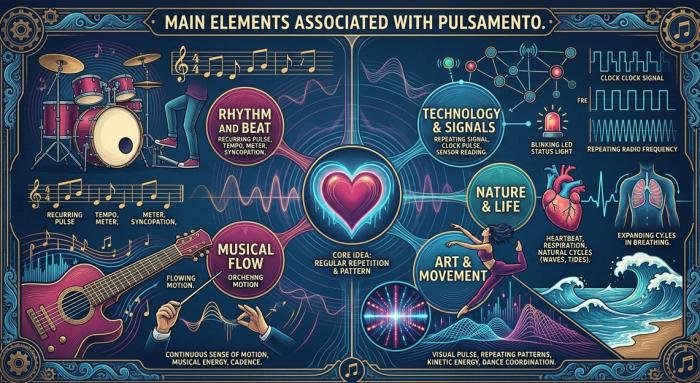
Several musical elements help explain how pulse and rhythmic movement function in a performance. These elements work together to create the structure and character of music.
| Musical element | Meaning | Role in rhythmic expression |
| Pulse | A recurring underlying beat | Establishes a sense of musical timing |
| Tempo | The speed of the beat | Influences whether music feels slow, moderate, or fast |
| Rhythm | The arrangement of sounds and silences | Creates patterns, variety, and movement |
| Meter | The organization of beats into recurring groups | Helps establish the structure of a musical passage |
| Accent | Emphasis placed on a particular sound or beat | Adds character and direction to a rhythm |
| Syncopation | Emphasis on unexpected or weaker beats | Creates rhythmic tension and energy |
| Dynamics | Changes in loudness | Influences the intensity and emotional impact of music |
| Groove | The combined rhythmic feel of a performance | Helps music feel cohesive, engaging, and natural |
How Pulsamento Works in Music
Pulsamento can be understood by examining how a musical pulse supports different parts of a composition. In many songs, the pulse is established through percussion, bass, repeated chords, or another recurring sound. Other instruments and vocal parts then create patterns around that foundation.
Consider a simple pop song. A drummer maintains a regular beat, the bass player follows the harmonic progression, and the guitarist plays chords in a repeated pattern. The singer delivers a melody that may contain long notes, short phrases, and pauses. Even though the parts differ, they remain coordinated through a shared sense of time.
In a more complex composition, the pulse may be less obvious. A classical piece may include changing time signatures, expressive pauses, or gradual tempo changes. Jazz musicians may use flexible phrasing and syncopation to create a sense of rhythmic freedom. Even in these situations, performers often rely on an internal awareness of timing to maintain musical coherence.
The pulse does not always need to be loud or clearly audible. Sometimes it is implied by the way a melody unfolds or by the relationships between musical phrases. Experienced listeners may recognize the beat even when no percussion instrument is present.
Pulsamento, viewed in this broad sense, emphasizes the continuity connecting musical events. It draws attention to the way timing, repetition, and movement help a composition develop from one moment to the next.
The Role of Pulsamento in Musical Performance
Musical performance requires coordination, concentration, and an awareness of time. Pulse and rhythm help musicians perform together while maintaining the character of a composition.
For solo performers, a steady internal pulse supports accuracy. A guitarist must coordinate the picking hand with the fretting hand, while a pianist must synchronize movements between both hands. Singers must manage the timing of words, breaths, and melodic phrases. Practicing with a consistent beat can help each performer develop greater control.
In an ensemble, shared timing becomes even more important. A band may include drums, bass, keyboards, guitars, and vocals. Each part contributes something different, but the musicians need to remain connected through tempo and rhythmic structure. If one performer consistently rushes or falls behind, the group may lose its sense of unity.
A conductor or bandleader can help maintain this coordination. Through gestures, eye contact, and musical cues, performers can follow changes in tempo and respond to one another.
Rhythmic flexibility also matters. Skilled musicians do not always play every note with mechanical precision. Depending on the style, they may use subtle timing variations to create warmth, tension, or expressive freedom. The goal is not necessarily to make every beat identical but to maintain a coherent musical relationship.
Pulsamento and Emotional Expression
Music affects people partly because rhythm influences the way sound is experienced over time. A rapid beat may create excitement, while a slow and spacious pattern may encourage reflection. These effects are not identical for every listener, but rhythmic characteristics can strongly influence a musical atmosphere.
A gentle pulse is common in lullabies, ambient music, and some acoustic ballads. The repeated timing may create a sense of calm and predictability. When combined with soft dynamics, smooth melodies, and sustained notes, it can contribute to a peaceful listening experience.
Fast rhythms are frequently used in dance music, energetic rock songs, and upbeat pop tracks. Repeated percussion patterns can encourage movement and make a performance feel more intense. Changes in tempo, volume, and rhythmic density can increase that energy.
Syncopation can create a different emotional response. By emphasizing unexpected parts of a beat, musicians can make a passage feel playful, restless, or surprising. This technique is common in jazz, funk, and many popular music styles.
Pulsamento in Dance and Physical Movement
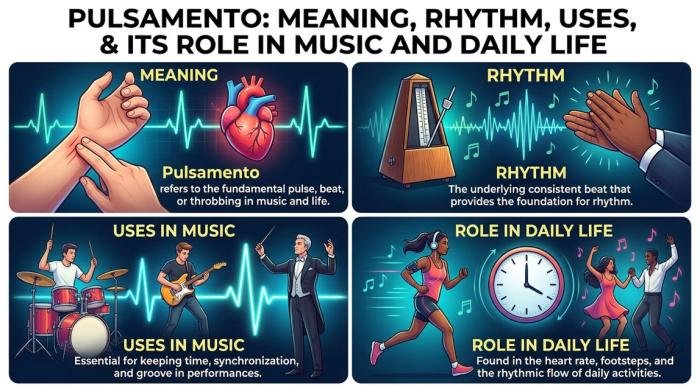
Dance provides a clear example of the connection between rhythmic sound and physical movement. Dancers often coordinate steps, gestures, and changes in direction with musical beats. A strong pulse makes it easier to recognize when movements should begin, continue, or change.
In social dancing, participants may use the beat to coordinate their steps with a partner. In group performances, dancers rely on shared timing to maintain synchronization. Even when choreography includes complex movements, the music often provides a rhythmic foundation.
Different dance styles use rhythm in different ways. Ballroom dancing may emphasize recognizable patterns and carefully timed steps. Hip-hop dance often incorporates syncopation, sharp accents, and changes in movement quality. Traditional dances may reflect the characteristic rhythms of their musical cultures.
Physical movement can also influence how people perceive rhythm. Clapping, tapping, stepping, or moving the body in time with music makes the pulse more tangible. Rather than simply hearing the beat, participants experience it through coordinated action.
Musicians and dancers frequently work together to create performances in which sound and movement reinforce each other. Percussion can emphasize a dancer’s movements, while changes in choreography can highlight a musical transition.
Pulsamento in Daily Life
Rhythmic patterns appear throughout everyday life, even when people are not listening to music. Walking, running, cycling, household activities, and repetitive work can all involve recurring movements. These patterns may not be musical compositions, but they demonstrate how repetition helps organize action.
Walking is a familiar example. Steps usually follow a recurring pattern, although the speed and regularity change depending on the person’s pace, surroundings, and physical condition. When people walk while listening to music, they may naturally coordinate their steps with the beat if the tempo feels comfortable.
Household activities can also involve repeated timing. Sweeping, washing dishes, chopping ingredients, or organizing objects may create patterns of movement. People sometimes develop a preferred rhythm that makes these activities feel more natural.
Workplaces use rhythm in different ways. Assembly tasks may require repeated actions, while team sports involve coordinated movements and rapid responses. In both situations, timing can influence efficiency and communication.
Daily routines can also create a sense of temporal structure. Regular times for waking, eating, working, and resting help divide the day into recognizable patterns. These routines are not equivalent to musical pulse, but they demonstrate a broader human familiarity with repetition and sequence.
Pulsamento and Exercise
Exercise is another area where rhythm can play a practical role. Many people listen to music while walking, jogging, cycling, or performing fitness routines. A steady beat can provide an external timing reference and help make repetitive movement feel more organized.
For example, a runner may choose music with a tempo that suits a comfortable running cadence. A person performing a low-impact workout may prefer music with a moderate beat, while a dance-based fitness class may use faster tracks to support energetic movement.
However, the best tempo depends on the activity and the individual. Music that feels motivating to one person may feel distracting or uncomfortable to another. Exercise intensity, fitness level, personal preference, and environmental conditions all influence whether music is helpful.
Rhythm can also support structured group exercise. Instructors may use music to coordinate movements, signal transitions, or maintain a consistent pace. Participants can follow repeated patterns more easily when the timing is predictable.
Music should not replace attention to physical needs. Exercisers should adjust their pace according to comfort, technique, and safety rather than forcing every movement to match a beat.
Pulsamento can be understood as the recurring rhythmic quality that helps connect sound with movement. Its practical value lies in providing timing and motivation, not in guaranteeing a particular physical result.
The Role of Pulsamento in Learning Music
Developing rhythmic awareness is an important part of musical education. Beginners often focus first on playing the correct notes, but accurate timing is equally important for producing a convincing performance.
Teachers may use clapping exercises to help students recognize beats and subdivisions. A student might clap four steady beats, then divide each beat into two equal parts. This simple activity develops awareness of how shorter rhythmic values fit within a larger pulse.
Metronomes are also useful tools. A metronome produces regular clicks at a selected tempo, allowing musicians to practice with a consistent timing reference. Students can begin slowly and increase the speed as their accuracy improves.
Counting aloud is another common method. Musicians may count beats using numbers or syllables while playing an instrument. This helps connect physical movement with an internal sense of musical time.
Listening exercises are equally valuable. Students can identify the beat in different songs, compare slow and fast tempos, or recognize changes in meter. Playing along with recordings provides additional experience in maintaining timing while responding to musical expression.
Practicing with other musicians develops another level of rhythmic awareness. Students must listen carefully, adjust their timing, and coordinate with the group rather than relying only on their own performance.
How to Practice Pulsamento and Improve Rhythmic Awareness
Improving rhythmic awareness does not require expensive equipment or advanced musical knowledge. Simple exercises can help beginners and experienced musicians develop a stronger sense of timing.
Start With a Steady Beat
Choose a familiar song with a clearly recognizable beat. Listen for the recurring pulse and clap or tap along. Try to maintain the timing without becoming distracted by changes in the melody.
Start with a comfortable tempo. If the beat feels difficult to follow, select a simpler song with a more regular rhythmic pattern.
Use a Metronome
Set a metronome to a moderate tempo and clap once with every click. Once the movement feels comfortable, clap twice per click to practice dividing each beat into two equal parts.
You can also try clapping on alternating beats while maintaining the underlying pulse internally. This exercise helps develop coordination and rhythmic independence.
Count While Playing
If you play an instrument, count the beats aloud during simple exercises. For example, count from one to four repeatedly while playing a basic chord pattern or scale.
Counting can help reveal timing problems that might otherwise go unnoticed. When the exercise becomes easier, try playing without speaking while keeping the same internal count.
Practice With Different Tempos
Listen to slow, moderate, and fast musical examples. Notice how the tempo affects your movements and the overall character of the music.
Avoid assuming that faster always means better. Accurate timing at a comfortable speed provides a stronger foundation than playing quickly with inconsistent rhythm.
Explore Different Musical Styles
Try listening to classical music, jazz, folk songs, rock, and electronic music. Pay attention to how each style uses accents, repetition, and rhythmic variation.
Some songs have a very obvious beat, while others use syncopation or flexible phrasing. Comparing these differences can improve your ability to recognize pulse in a variety of musical situations.
Record and Review Your Practice
Recording a short performance can help you identify whether you are rushing, slowing down unintentionally, or losing the beat during difficult passages.
Listen critically but patiently. Focus on one aspect of timing at a time instead of trying to correct every mistake immediately.
Regular, focused practice is generally more productive than occasional long sessions. By gradually improving coordination and listening skills, musicians can develop a stronger sense of rhythmic continuity.
Benefits of Rhythmic Awareness in Everyday Activities
Rhythmic awareness can be useful beyond musical performance. Recognizing recurring patterns and coordinating movement with timing can support several ordinary activities.
One potential benefit is improved coordination. Activities that involve repeated movements, such as dancing, playing sports, or practicing an instrument, often require people to coordinate different actions within a predictable sequence.
Rhythmic activities may also encourage attention. Following a musical pattern requires listening, anticipating what comes next, and responding at the appropriate time. These demands can make rhythm-based activities engaging forms of practice.
Music can also contribute to enjoyment and motivation. People may find walking, cleaning, or exercising more pleasant when accompanied by songs they enjoy. In these situations, a familiar beat can provide a sense of structure and make repetitive tasks feel less monotonous.
Group rhythmic activities may encourage social interaction. Singing together, playing percussion, or dancing in a group requires participants to pay attention to one another and coordinate their actions. These shared experiences can create opportunities for communication and cooperation.
Pulsamento in Modern Music Production
Modern music production offers many ways to create, control, and modify rhythmic patterns. Digital audio workstations, drum machines, synthesizers, and sampling tools allow producers to build beats with considerable precision.
A producer may begin with a simple kick drum pattern and add snare hits, hi-hats, bass, and other sounds. Each layer contributes to the overall rhythmic feel. The producer can then adjust timing, volume, and sound selection to create a distinctive groove.
Many digital tools use a tempo setting measured in beats per minute, commonly abbreviated as BPM. This value describes the number of beats occurring in one minute. A higher BPM generally indicates a faster pulse, although the perceived speed can also depend on the rhythmic arrangement and musical context.
Producers may use quantization to align musical events with a rhythmic grid. This can make a performance more consistent, especially in electronic and dance music. However, excessive correction may reduce natural variation when a more human feel is desired.
Some producers deliberately introduce small timing differences to create a relaxed or expressive groove. They may also shift accents, change drum patterns, or introduce breaks that interrupt the expected pulse.
The Future of Pulsamento in Music and Daily Life
Technology continues to influence how people create, perform, and experience rhythm. Digital instruments, interactive music software, and artificial intelligence tools can generate rhythmic patterns, analyze timing, and support music production.
These developments make it easier for beginners to experiment with musical ideas. A person without formal instrumental training can use software to arrange percussion, create repeated patterns, and explore different tempos. Experienced musicians can use similar tools to refine performances and experiment with complex arrangements.
Live performance remains important as well. Human musicians respond to one another through listening, gesture, and subtle timing adjustments. These interactions can produce rhythmic experiences that feel spontaneous and expressive.
In education, digital metronomes and practice applications provide accessible ways to work on timing. Students can adjust tempo, repeat difficult passages, and compare their performances over time. Such tools can support practice, although they do not replace careful listening or musical judgment.
Outside music, people continue to encounter rhythmic patterns through exercise, dance, games, and daily routines. These experiences demonstrate the ongoing relevance of repetition and timing in human activity.
The future of pulsamento as a term may depend on how musicians, writers, and educators use it. Regardless of its precise terminology, the underlying relationship between pulse, rhythm, and movement remains central to how people organize and experience sound.
Conclusion
Pulsamento highlights the important relationship between rhythm, movement, and musical expression. Whether experienced through listening to music, playing an instrument, dancing, or following everyday routines, rhythmic patterns help create a sense of timing and continuity. Although the term may have different meanings depending on its context, its connection to pulse offers a helpful perspective on how sound and movement work together.
By paying attention to rhythm in music and daily activities, people can develop a greater appreciation for the patterns that make experiences feel organized, engaging, and expressive.
FAQs
Q1: What is pulsamento?
Ans: Pulsamento is a term associated with pulse, rhythmic movement, and recurring patterns of sound. In musical discussions, it can describe the sense of continuity created by a repeated beat or rhythmic pattern. Its exact meaning depends on the context because it is not a universally standardized technical term across all musical traditions.
Q2: What is the difference between pulsamento and rhythm?
Ans: Pulse is the underlying, recurring beat that helps organize musical time. Rhythm is the arrangement of sounds and silences around that beat. Pulsamento can be used as a broader way to discuss the connection between pulse and rhythmic movement, but the terms should not automatically be treated as identical.
Q3: How is pulsamento used in music?
Ans: Pulsamento can describe the rhythmic foundation that connects different parts of a musical performance. Drums, bass, repeated chords, and other instruments may establish a pulse while melodies and percussion create varied rhythmic patterns. This relationship helps musicians coordinate their timing and gives a composition a sense of movement.
Q4: Can pulsamento be experienced in daily life?
Ans: Yes. The concept can be used to discuss recurring patterns in activities such as walking, dancing, exercising, and performing routine tasks. These activities often involve repeated movements and timing. However, everyday rhythms are related to musical pulse by analogy rather than being identical musical phenomena.
Q5: Does pulsamento help musicians improve their timing?
Ans: Thinking about pulse and rhythmic continuity can help musicians pay closer attention to timing. Practicing with a metronome, clapping along with songs, counting beats, and playing with other musicians can develop rhythmic accuracy. Consistent practice is important, and progress depends on the individual’s experience and goals.
Q6: What role does pulsamento play in dance?
Ans: In dance, pulse provides a timing reference that helps performers coordinate steps, gestures, and changes in movement. Dancers may follow strong beats, respond to syncopated rhythms, or interpret musical accents through body movements. The relationship between music and movement varies according to the dance style.
Q7: Is pulsamento the same in every musical genre?
Ans: No. Different genres organize pulse and rhythm in different ways. Classical music may use flexible timing and changing meters, jazz often features syncopation and improvisation, and electronic music may rely on programmed beats. The broad concept of rhythmic movement applies across these styles, but musical practices and terminology vary.