
Secret Hitler Game: Rules, Roles & Winning Strategies
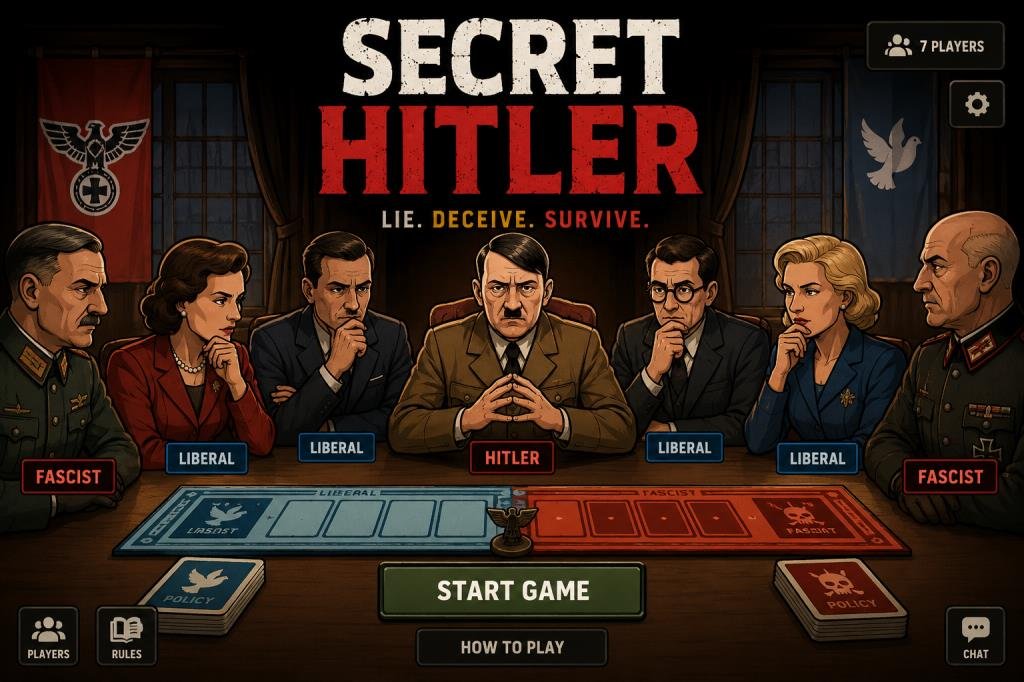
The secret hitler game is a hidden-role social deduction game built around elections, secret identities, policy decisions, deception, and table-wide discussion. Players are divided into two political teams, but only some people know exactly who is on their side.
That information gap is what creates the game’s tension: a completely innocent player can look suspicious, while a skilled deceiver can appear trustworthy for several rounds. For beginners, the hardest part is usually not the basic objective. It is keeping track of who voted for whom, which policies were enacted, what players claimed during legislative sessions, and when presidential powers become available.
Read more: Pokémon Trading Card Game Pocket: Beginner’s Guide, Tips & Strategies 2026
Brings those elements together in one practical resource. It covers setup, roles, rules, turn order, winning conditions, beginner tactics, advanced deduction, common mistakes, and useful examples. The rules have been checked against the published rulebook and multiple rule references, while the strategy sections add practical reasoning that goes beyond simply repeating the rules.
What Is the Secret Hitler Game?
Secret hitler game is a 5–10 player social deduction party game set in the political atmosphere of 1930s Germany. Each participant secretly belongs to either the Liberal or Fascist team, with one Fascist player holding the special Hitler role.
The Liberals have more players but less information. Fascists have fewer members but possess important information about their team. Hitler’s identity creates another layer of uncertainty because the Fascist team needs to protect Hitler while eventually getting that player into the Chancellor position. The game combines three major activities:
- Election: players approve or reject a proposed government.
- Legislative session: the President and Chancellor secretly handle policy cards.
- Deduction: everyone analyzes voting, behavior, claims, and previous decisions.
Secret Hitler Game Setup
Before starting, choose the Fascist board that matches the number of players. The official game contains 17 policy tiles: six Liberal and eleven Fascist. Each player receives a secret role, a corresponding party membership card, and voting cards.
Player and Role Distribution
| Players | Liberals | Fascists + Hitler |
| 5 | 3 | 1 + Hitler |
| 6 | 4 | 1 + Hitler |
| 7 | 4 | 2 + Hitler |
| 8 | 5 | 2 + Hitler |
| 9 | 5 | 3 + Hitler |
| 10 | 6 | 3 + Hitler |
How the Secret Role Reveal Works
After roles are distributed, players secretly check their identities. The Fascist information phase differs according to player count. With 5–6 players, Fascists and Hitler identify each other. With 7–10 players, ordinary Fascists identify one another and identify Hitler, while Hitler does not identify the ordinary Fascists.
This distinction matters strategically. It means Hitler cannot simply coordinate openly with the Fascist team, even though the Fascists know Hitler’s identity.
Choosing the First President
A starting President is selected randomly. After that, the Presidency moves clockwise around the table as the game progresses. The President does not simply make policy decisions alone. The player must first nominate an eligible Chancellor, and the entire table then votes on the proposed government.
Secret Hitler Game Roles Explained
Understanding the roles is essential because each team has different information and different priorities.
Liberal Players
Liberals form the larger team, but individual Liberals begin with very little reliable information. Their objectives are to:
- Enact five Liberal policies, or
- Successfully identify and assassinate Hitler.
A Liberal therefore needs to gather information rather than simply accuse people. A common beginner mistake is assuming that a Liberal must always vote “no” whenever a Fascist policy seems possible. That approach is too simplistic. Sometimes an uncertain government may still provide valuable information, while repeatedly rejecting governments can trigger the election tracker.
Fascist Players
Fascists need to advance the Fascist policy track or help Hitler become Chancellor after the appropriate point in the game. Their strongest resource is not necessarily lying. It is controlling how information is interpreted. A Fascist may sometimes support a Liberal government to appear trustworthy.
In another situation, they may deliberately create disagreement between two Liberals. The best deception often looks like normal uncertainty rather than an obvious attempt to manipulate the table.
Hitler
Hitler is part of the Fascist team but has special victory conditions. If Hitler is elected Chancellor after three or more Fascist policies have already been enacted, the Fascists immediately win. Hitler can also benefit from surviving long enough to remain a viable Chancellor candidate.
That creates an interesting strategic problem: Hitler generally wants to appear credible without becoming so suspicious that the table refuses to elect them.
Secret Hitler Game Rules Explained
The core rules are easier to remember when divided into three stages: election, legislative session, and executive action.
1. Election Phase
The current Presidential Candidate chooses an eligible Chancellor Candidate. The whole table then discusses the proposed government and votes simultaneously. A majority of Ja! votes approves the government. If the vote fails, the Presidency moves to the next player and the Election Tracker advances.
One important rule is that recent government members can face Chancellor eligibility restrictions. The exact restriction also depends on the player count, so hosts should consult the appropriate board or rulebook rather than relying on a simplified house explanation.
2. Legislative Session
Once a government is approved, the President draws three policy tiles. The President secretly discards one and gives the remaining two to the Chancellor. The Chancellor secretly discards one and enacts the final policy. The discarded policies remain hidden.
This is one of the most important information mechanics in the game because the table cannot directly verify what cards the President or Chancellor actually saw. The two players can therefore make conflicting claims, and everyone else must decide whose story is more believable.
3. Executive Action
Certain Fascist policies grant the President special powers. Depending on the position reached on the Fascist track, these powers can include:
- Investigating a player’s party membership
- Calling a special election
- Peeking at upcoming policy cards
- Executing another player
What Happens When Three Governments Fail?
If three governments are rejected consecutively, the top policy tile is enacted automatically. This is called the election tracker or “chaos” mechanism. Importantly, the policy’s executive power is ignored in this situation. The tracker then resets, and normal election restrictions are cleared for the next government. This rule prevents a table from rejecting every candidate indefinitely.
How the Secret Hitler Game Ends
There are several possible victory routes.
Liberal Victory
Liberals win if:
- Five Liberal policies are enacted, or
- Hitler is successfully executed.
Fascist Victory
Fascists win if:
- Six Fascist policies are enacted, or
- Hitler is elected Chancellor after three Fascist policies have already been enacted.
Secret Hitler Game Turn Order
| Step | Phase | What Happens |
| 1 | Presidential Candidacy | The Presidency moves clockwise to the next eligible player. |
| 2 | Chancellor Nomination | The President selects an eligible Chancellor Candidate. |
| 3 | Government Vote | All players vote simultaneously to approve or reject the proposed government. |
| 4 | Policy Session | The President draws 3 policies, discards 1, and passes 2 to the Chancellor. The Chancellor discards 1 and enacts the remaining policy. |
| 5 | Executive Power | If the enacted Fascist policy grants a presidential power, the President must use it before the next round. |
| 6 | Next President | The Presidency normally moves clockwise to the next eligible player unless a special election changes the order. |
Beginner Strategy for the Secret Hitler Game

New players often try to identify Hitler immediately. That is usually less effective than collecting evidence gradually.
Track Voting Patterns
Don’t record only whether someone voted yes or no. Ask:
- Who proposed the government?
- Who supported it?
- Who opposed it?
- What policy followed?
- Who benefited from that outcome?
Compare Claims
Suppose a President says:
“I saw two Fascist policies and one Liberal policy.”
The Chancellor says:
“I received two Fascist policies.”
That does not automatically prove either player is lying. The deck itself introduces uncertainty. Instead, compare this event with previous claims and future behavior.
Avoid Instant Trust
A player who correctly identifies a Fascist once is not automatically Liberal. Likewise, a player who makes one suspicious decision is not necessarily Fascist. Strong deduction uses patterns rather than isolated moments.
Ask Better Questions
Instead of asking, “Are you Fascist?” ask:
- “Why did you nominate that Chancellor?”
- “Why did you vote against that government?”
- “Who would you trust as President next round?”
- “What information changed your opinion?”
Advanced Strategy for the Secret Hitler Game
Experienced players can gain an advantage by treating the table as an information system.
Build a Voting History
Keep a mental or written record of major government votes. For example:
| Round | President | Chancellor | Result | Policy | Useful Question |
| 1 | A | B | Passed | Liberal | Who supported them? |
| 2 | B | C | Passed | Fascist | Who had incentive? |
| 3 | C | D | Failed | — | Who rejected the pair? |
| 4 | D | A | Passed | Fascist | Does this fit earlier claims? |
Use Information From Presidential Powers Carefully
An investigation can tell a President about party membership, but that information does not necessarily reveal every detail of a player’s role. This distinction matters because Hitler’s party membership is Fascist while the special role itself is hidden. A President can therefore receive genuine information and still need additional deduction.
Think About Incentives
Ask what each player gains from a decision. For example, if someone strongly supports a government that could safely pass another Liberal policy, that vote may be consistent with either team. But if someone repeatedly pushes a particular player into powerful positions after several suspicious outcomes, the pattern deserves more scrutiny.
Don’t Waste Execution Powers
Execution is powerful because removing a player also removes their future voting influence. However, executing the wrong person can leave the Liberals with less information and fewer voices. A President should therefore consider:
- Current policy track
- Previous voting behavior
- Player claims
- Whether Hitler may be among the realistic candidates
- What information will be lost after the execution
Three Practical Strategy Examples
Two Players Give Different Stories
The President says the Chancellor received two Fascist policies. The Chancellor says there was one Liberal and one Fascist policy. A weak response is to immediately declare one player a liar. A stronger response is to examine their earlier behavior.
Did either player previously make claims that were confirmed or contradicted? Who supported the government? Who benefited from the resulting policy? The contradiction becomes one piece of evidence rather than the entire case.
A Suspicious Government Passes
Imagine a player with a poor voting history proposes another government with a player who has recently received public suspicion. Instead of rejecting it automatically, ask why the government might be useful. Sometimes accepting a questionable government produces valuable information. Other times, the risk is simply too high. The correct decision depends on the current policy track and Hitler’s possible position.
The Table Is Near a Fascist Victory
Late in the game, ordinary standards should change. A government that might have been acceptable early can become extremely dangerous after three Fascist policies because electing Hitler Chancellor can immediately end the game. This is why strategy should respond to game state, not just personal trust.
Common Secret Hitler Mistakes to Avoid
Mistake 1: Treating Every Fascist Policy as Proof: A Fascist policy can result from several different possibilities, including the policy deck. One bad outcome does not establish a player’s identity.
Mistake 2: Ignoring the Election Tracker: Repeatedly rejecting governments can create an automatic policy enactment. Sometimes players focus so heavily on finding the “perfect” government that they overlook the danger created by continued failed elections.
Mistake 3: Revealing Too Much: A Liberal who announces every suspicion immediately can accidentally help Fascists understand which players are trusted. Information has strategic value. Consider when to reveal it.
Mistake 4: Playing the Same Way Every Round: Predictability makes deception easier to detect. Both Liberals and Fascists benefit from adapting their communication to the evolving table.
Mistake 5: Forgetting the Difference Between Party and Role: Party membership and special role information are not identical. This becomes particularly important when presidential investigations occur.
How to Improve Your Table’s Gameplay
A better experience does not require players to become experts before their first session. For hosts, explain the round structure before distributing roles. Keep the policy deck and trackers visible, and make sure everyone understands that legislative discussions happen only after the private policy exchange is complete.
For beginners, consider encouraging players to explain the reasoning behind important votes. This creates useful discussion without requiring everyone to memorize advanced strategy. For experienced groups, establish a habit of separating facts, claims, and assumptions.
For example:
- Fact: Player A voted against Government X.
- Claim: Player A says they distrusted the Chancellor.
- Assumption: Player A must therefore be Fascist.
Secret Hitler Game Compared With Other Social Deduction Games
The secret hitler game has similarities to Mafia and Werewolf, but its policy and government mechanics create a different type of deduction.
| Feature | Secret Hitler | Mafia | Werewolf |
| Hidden teams | Yes | Yes | Yes |
| Public voting | Yes | Usually | Usually |
| Government formation | Yes | No | No |
| Policy system | Yes | No | No |
| Special powers | Yes | Varies | Yes |
| Secret leadership role | Hitler | Varies | Varies |
| Legislative deception | Yes | No | No |
| Player elimination | Yes | Yes | Yes |
How to Host a Better Game Night

A good host can make the experience considerably smoother.
Before the Game:
- Confirm the player count.
- Select the correct Fascist board.
- Prepare the role envelopes.
- Shuffle the policy cards.
- Explain the win conditions.
- Explain the election and legislative phases.
During the Game:
Keep the table focused on the current round. If a rules dispute occurs, pause the game and check the official rules rather than inventing an answer. This is particularly useful for eligibility restrictions, special elections, investigations, executions, and veto situations.
After the Game:
A short post-game discussion can be valuable. Ask:
- When did the table first become suspicious?
- Which vote changed the game?
- Which player managed information most effectively?
- Was the winning team helped by a risky decision?
Final Thoughts
The biggest challenge in the secret hitler game is not simply memorizing the rules—it is knowing whom to trust when every vote, policy, and accusation can change the outcome. A clear understanding of roles, elections, policy sessions, and victory conditions gives players a stronger foundation, while careful observation and strategic voting help turn uncertainty into useful information.
Brings those elements together to make the game easier to follow for beginners and more engaging for experienced players. By applying the practical strategies and examples covered here, players can make smarter decisions, recognize suspicious patterns, and enjoy more strategic and memorable game nights.
Frequently Asked Questions
Q1: How many players can play Secret Hitler?
Ans: The game is designed for 5 to 10 players. The number of Liberals and Fascists changes with the player count, so always use the appropriate role distribution for the group size.
Q2: What is the main goal of the Secret Hitler game?
Ans: Liberals try to enact five Liberal policies or assassinate Hitler. Fascists try to enact six Fascist policies or get Hitler elected Chancellor after three Fascist policies have been enacted.
Q3: How does a government get elected?
Ans: The Presidential Candidate nominates an eligible Chancellor Candidate, and all players vote simultaneously. The government is approved when it receives a majority of Ja! votes. If the vote fails, the Presidency moves forward and the Election Tracker advances.
Q4: What happens if three governments are rejected in a row?
Ans: The top policy from the deck is automatically enacted. Any executive power associated with that policy is ignored, and the Election Tracker resets afterward.
Q5: Can Hitler win by becoming Chancellor?
Ans: Yes. If at least three Fascist policies have already been enacted and Hitler is subsequently elected Chancellor, the Fascist team wins immediately.
Q6: Can the President and Chancellor reveal their policy cards?
Ans: The policy cards are handled secretly during the legislative session, and discarded policies are not revealed to the group. Players therefore have to evaluate the President’s and Chancellor’s statements rather than directly checking their claims.
Q7: What happens when a player is executed?
Ans: The President announces the execution. If the eliminated player is Hitler, the Liberals immediately win. If the player is not Hitler, their role is not revealed, and they leave the game without voting or participating further.