
How Mogothrow77 Software Is Built: Development Process and Technology
Building modern software requires a combination of technical knowledge, proper planning, and the right development technologies. From the initial concept to the final release, every stage plays an important role in creating a reliable and user-friendly application.
How Mogothrow77 Software Is Built: Development Process and Technology is a topic that highlights the importance of software architecture, programming, database management, testing, and deployment. Understanding these development stages helps explain how different technical components work together to create a functional software solution.
What Is Mogothrow77 Software?
Mogothrow77 software can be discussed as a software development subject in which the main focus is the process, technology, and technical decisions involved in creating an application. Like other software projects, building a reliable product requires more than writing code. Developers must understand the purpose of the application and establish a technical structure that supports its intended functions.
Read More: Why Does Ozdikenosis Kill You? Medical Facts and Evidence
A software application generally consists of several connected components. These may include a user interface, application logic, a database, security controls, and server-side services. Each component has a specific responsibility, and all of them must work together to deliver a consistent user experience.
For example, when someone enters information into an application, the user interface collects that information. The application logic processes the request, and the database may store the resulting information. The system then returns an appropriate response to the user.
How Mogothrow77 Software Is Built: The Initial Planning Process
The first stage of software development is planning. Before developers begin programming, they need to understand what the application is supposed to accomplish. This stage establishes the project’s direction and prevents unnecessary development work. Planning usually begins with identifying the problem that the software is intended to solve. Developers consider the intended audience, expected features, common user activities, and technical requirements. These considerations help determine which functions should be included in the first version.
A project team may also create a development roadmap that organizes tasks according to priority. Important functions are usually addressed before optional features. This makes it easier to manage time, resources, and development costs. Some common planning activities include:
- Defining the main purpose of the software.
- Identifying the intended users.
- Listing the required application features.
- Establishing technical and performance requirements.
- Estimating development time and resources.
- Identifying possible security and maintenance concerns.
- Preparing a schedule for development and testing.
Development Process and Technology Used in Software Projects
The technologies selected for a software project depend on its features, expected traffic, development budget, and long-term requirements. A development team should choose tools that match the project’s needs rather than selecting technologies simply because they are popular.
The following table presents examples of technologies commonly used in modern software development. These are illustrative options, not a verified list of Mogothrow77’s actual technology stack.
| Development Area | Example Technology | Main Purpose |
| Frontend | HTML, CSS, JavaScript | Building user interfaces |
| Backend | Python, Node.js | Processing application logic |
| Database | PostgreSQL, MySQL | Storing and managing information |
| Version Control | Git | Tracking code changes |
| API Development | REST APIs | Connecting application components |
| Testing | Pytest, Jest | Checking software functionality |
| Deployment | Docker | Packaging application environments |
| Cloud Hosting | AWS, Azure | Hosting applications and services |
| Security | HTTPS, authentication tools | Protecting users and information |
Understanding the Software Architecture
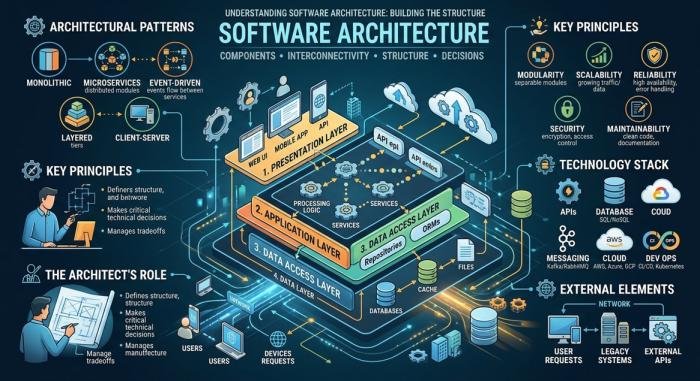
Software architecture describes how the different parts of an application are organized and connected. It provides a structural plan that guides developers while they build and maintain the product.
A well-designed architecture separates different responsibilities. For example, the interface should handle user interaction, while the backend should process business rules and communicate with the database.
Monolithic Architecture
A monolithic architecture combines most application functions into one deployable software unit. It is often suitable for smaller projects because it can be easier to develop, test, and deploy.
For example, a basic application might contain its user interface, business logic, and database communication within one main application structure. Its main advantages include:
- A relatively simple development process.
- Easier initial deployment.
- Fewer infrastructure requirements.
- Straightforward testing for smaller applications.
Modular Architecture
A modular architecture divides an application into separate components based on their responsibilities. Each module handles a particular part of the system while communicating with other modules through defined interfaces.
For example, a software platform might have separate modules for user accounts, notifications, payments, and reporting.
Microservices Architecture
Microservices architecture divides an application into independently deployable services. Each service performs a specific function and communicates with other services through APIs or messaging systems.
This approach can be useful for larger applications with complex requirements. However, it introduces additional challenges involving service communication, monitoring, deployment, and data consistency.
How Programming Shapes Mogothrow77 Software Development
Programming is one of the most important stages in building any software application. Once the requirements and architecture have been established, developers begin converting the project plan into functional code. The programming language depends on the application’s requirements.
Python for Backend Development
Python is a popular programming language used for web applications, automation, data processing, and backend development. Its readable syntax makes it suitable for projects that require organized application logic. Developers can use Python frameworks such as Django and Flask to build backend functionality.
These frameworks provide tools for handling requests, managing application routes, connecting databases, and implementing authentication. Python can also support data processing and integration with external services. Its flexibility makes it useful for applications that require different types of functionality.
JavaScript for Interactive Features
JavaScript helps developers create interactive experiences within web applications. It allows websites to respond to user actions without requiring a complete page reload for every interaction. Developers can use JavaScript frameworks and libraries to build dynamic interfaces, manage application states, and communicate with backend services.
For example, a user dashboard may use JavaScript to update notifications, display account information, or validate form entries.
Writing Clean and Maintainable Code
Good programming is not simply about making an application work. Developers should also write code that other team members can understand and maintain. Some useful programming practices include:
- Using meaningful variable and function names.
- Organizing code into reusable modules.
- Avoiding unnecessary duplication.
- Adding comments where technical explanations are helpful.
- Following consistent coding standards.
- Reviewing code before merging changes.
- Keeping development documentation updated.
Database Management and Information Storage
A database is an important component of applications that need to store, retrieve, and manage information. Depending on its purpose, software may need to maintain user profiles, account settings, activity records, application preferences, or other information.
Database selection should be based on the structure and expected use of the application. Developers need to consider data relationships, storage requirements, query performance, security, and future growth.
Relational Database Systems
Relational databases organize information into tables containing rows and columns. They are particularly useful when application data has clearly defined relationships. PostgreSQL and MySQL are two widely used relational database management systems.
For example, a database for an online platform might contain separate tables for users, products, transactions, and activity records. Relationships between these tables help maintain organized information.
Database Design and Organization
A properly designed database reduces unnecessary duplication and makes information easier to manage. Developers generally begin by identifying the types of information an application needs to store. They then define tables, fields, relationships, and rules for handling information. Important database design practices include:
- Creating clearly structured tables.
- Using appropriate primary and foreign keys.
- Avoiding unnecessary duplicate records.
- Applying validation rules.
- Optimizing frequently used queries.
- Planning regular backups.
- Monitoring database performance.
Protecting Stored Information
Database security should be considered throughout development. Applications may contain personal or business information that requires appropriate protection. Developers can apply access controls, encrypted connections, secure authentication, and regular backup procedures to reduce risks.
Database permissions should also follow the principle of least privilege. This means users and application services should receive only the access required to perform their assigned tasks.
Creating a User-Friendly Software Interface
The user interface is the part of an application that people interact with directly. Even technically advanced software can become difficult to use if its interface is confusing or poorly organized.
A good interface should make common activities straightforward. Users should be able to find important functions, understand available options, and complete tasks without unnecessary complications.
Frontend Design and Development
Frontend development focuses on the visual and interactive elements of an application. HTML provides the structure, CSS controls presentation, and JavaScript adds interactive behavior. Developers may also use frontend frameworks to organize larger interfaces into reusable components. For example, a dashboard could contain:
- A navigation menu.
- A user account section.
- A main content area.
- Search and filtering options.
- Notification indicators.
- Settings and profile controls.
Responsive Design
Modern software should work across different screen sizes. Users may access an application through desktop computers, laptops, tablets, and smartphones. Responsive design allows interface elements to adjust according to the available screen space.
Developers commonly use flexible layouts, CSS media queries, scalable images, and responsive navigation patterns to achieve this. Testing on different screen sizes helps identify problems such as overlapping text, difficult navigation, and buttons that are too small to use comfortably.
Accessibility and Usability
Accessibility helps make software usable by people with different abilities and interaction requirements. Developers should consider readable text, sufficient color contrast, keyboard navigation, meaningful labels, and alternative text for relevant images. A clear interface benefits all users, not only those who rely on accessibility features.
How API Integration Connects Software Components
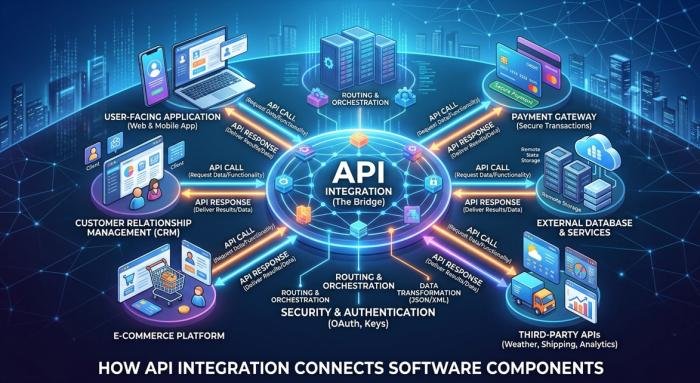
Application programming interfaces, commonly known as APIs, allow different software components to communicate with each other. An application may need to connect with an external payment service, notification provider, authentication system, or reporting platform. APIs provide a structured method for exchanging information between these systems.
REST APIs are a common approach for communication between web applications and backend services.
For example, when a user submits a registration form, the frontend can send the information to a backend endpoint. The backend validates the request, processes the information, and returns an appropriate response. A reliable API implementation should include:
- Clearly defined endpoints.
- Appropriate request and response formats.
- Authentication and authorization.
- Input validation.
- Error handling.
- Rate limiting where necessary.
- API documentation.
Software Testing and Quality Assurance
Testing helps developers determine whether an application behaves as expected. It is an important stage because even carefully written software can contain unexpected errors. Quality assurance involves checking individual features, interactions between components, security behavior, and overall application performance.
Unit Testing
Unit testing checks individual functions or components separately. It helps developers identify errors before they affect other parts of the application. A developer may test a registration function to confirm that it correctly validates email addresses and handles missing information.
Integration Testing
Integration testing checks whether different components work correctly together. A database connection, authentication system, and backend API may each work independently but still encounter problems when connected. Integration testing helps identify these issues.
Functional Testing
Functional testing verifies whether the application performs the tasks expected by its users. Examples include checking login functionality, form submissions, account settings, search features, and navigation.
Performance Testing
Performance testing examines how software behaves under different workloads. Developers may evaluate:
- Page loading speed.
- Server response time.
- Database query performance.
- Resource consumption.
- Application behavior under heavy traffic.
- System stability during extended use.
Security Practices in Software Development
Security is an important consideration throughout the development lifecycle. It should not be treated as a final task that developers complete immediately before deployment.
Applications may process sensitive information, manage user accounts, and communicate with external services. Weak security practices can expose these systems to unauthorized access and other threats.
Deployment and Software Release Management
Deployment is the stage where an application is prepared and made available in its intended environment. After development and testing, developers need to configure the infrastructure, prepare application settings, and make sure the software can operate reliably. The deployment process depends on the application’s architecture and hosting requirements.
Choosing a Hosting Environment
Software can be deployed using different hosting solutions. The right choice depends on expected traffic, performance requirements, available resources, and operational costs. Common hosting options include:
- Cloud hosting: Provides computing resources through cloud service providers.
- Virtual private servers: Offers dedicated virtual resources within a physical server.
- Dedicated servers: Provides an entire physical server for an application.
- Container hosting: Runs applications inside isolated container environments.
Using Docker for Deployment
Docker is a containerization platform that helps developers package applications with the dependencies and configuration required to run them. Containers make it easier to maintain consistent environments across development, testing, and production.
For example, developers can configure an application to run with a particular Python version and its required libraries. This reduces differences between development machines and deployment servers.
Continuous Integration and Continuous Deployment
Continuous integration and continuous deployment, commonly called CI/CD, help automate parts of the software delivery process. Continuous integration involves regularly combining code changes and running automated checks. Continuous deployment or delivery helps prepare tested changes for release. A typical CI/CD process may include:
- A developer submits updated code.
- The version control system records the changes.
- Automated tests run.
- The system checks the application build.
- Approved changes are prepared for deployment.
- The updated application is released.
- Developers monitor the application after deployment.
Maintenance and Continuous Software Improvement
Software development does not end when an application is released. Applications require ongoing maintenance to remain reliable, secure, and compatible with changing technical environments. Over time, users may request additional features, developers may identify performance problems, and external technologies may receive important updates. Maintenance helps address these changes without requiring the entire application to be rebuilt.
Bug Fixes and Technical Updates
A bug is an error that causes software to behave incorrectly. Developers need a process for identifying, prioritizing, and fixing reported problems. Bug reports should include useful information about the issue, such as the affected feature, steps to reproduce the problem, and the expected behavior. After implementing a fix, developers should test the affected functionality to make sure the correction does not introduce another problem.
Performance Monitoring
Performance monitoring helps developers understand how an application behaves after deployment. They can monitor server response times, application errors, database activity, resource consumption, and system availability.
Monitoring tools can also generate alerts when important performance indicators move outside acceptable limits. This makes it easier to identify technical problems before they significantly affect users.
Challenges Involved in Building Mogothrow77 Software
Developing software involves technical and organizational challenges. Even a well-planned project can encounter problems during programming, testing, deployment, and maintenance. Understanding these challenges helps development teams prepare suitable solutions.
Managing Technical Complexity
As an application grows, its components and dependencies can become more difficult to manage. Developers may need to coordinate frontend functionality, backend services, databases, APIs, and external integrations.
Using modular code, clear documentation, and consistent development standards can help reduce unnecessary complexity.
The Importance of Choosing the Right Development Team
A successful software project depends on the people responsible for designing, developing, testing, and maintaining it. Different specialists contribute different skills throughout the development process. A typical development team may include:
| Team Member | Main Responsibility |
| Project Manager | Coordinates tasks and schedules |
| Software Architect | Plans the technical structure |
| Frontend Developer | Builds the user interface |
| Backend Developer | Develops application logic |
| Database Developer | Manages data structures |
| QA Engineer | Tests software functionality |
| Security Specialist | Reviews security practices |
| DevOps Engineer | Manages deployment and infrastructure |
How the Software Development Lifecycle Works
The software development lifecycle, commonly called SDLC, provides a structured approach to building and maintaining applications. It organizes development into stages so that teams can manage requirements, technical work, and quality checks. The following stages represent a common software development lifecycle:
1. Requirement analysis: Developers identify the application’s purpose, intended users, and necessary functionality.
2. Planning: The team establishes priorities, resources, schedules, and technical requirements.
3. Design: Developers prepare the architecture, database structure, interface layouts, and component relationships.
4. Development: Programmers write the code and connect the different application components.
5. Testing: The application is checked for functional errors, security problems, compatibility issues, and performance limitations.
6. Deployment: The completed software is configured and released into its intended environment.
7. Maintenance: Developers monitor the application, fix problems, update dependencies, and introduce improvements.
Future Possibilities for Mogothrow77 Software Development
Software development continues to change as new tools, programming techniques, and infrastructure solutions become available. Future development opportunities may include artificial intelligence integration, automated workflows, improved analytics, and more flexible application architecture.
Artificial intelligence can support selected tasks such as text processing, recommendations, classification, and automated assistance. However, these features should be introduced only when they provide practical value.
Cloud-native technologies can also help applications manage changing workloads. Developers may use managed databases, container orchestration, and automated infrastructure tools to improve operational flexibility.
Conclusion
The development of software involves much more than writing lines of code. It requires a structured approach that brings together planning, programming, interface design, database integration, security, and continuous maintenance. How Mogothrow77 software is built reflects the broader principles involved in developing modern applications, where every technical decision can influence performance, usability, and reliability.
By following an organized development process and selecting suitable technologies, software teams can create applications that meet user expectations and remain adaptable to future improvements.
Frequently Asked Questions (FAQ)
Q: What is Mogothrow77 software?
Ans: Mogothrow77 software is the subject of this software development discussion. Understanding its development involves examining how applications are planned, programmed, tested, deployed, and maintained. Its exact product features should be confirmed through official documentation.
Q: How Mogothrow77 software is built?
Ans: Software of this type can be developed through requirement analysis, architecture planning, programming, database integration, interface development, testing, and deployment. These stages help transform an initial concept into a functional application.
Q: Which programming languages can be used to build Mogothrow77 software?
Ans: Python and JavaScript are examples of programming languages used in modern application development. Python can support backend functionality, while JavaScript is widely used for interactive web interfaces. The actual languages used by Mogothrow77 have not been independently verified.
Q: What database technology can support Mogothrow77 software?
Ans: PostgreSQL and MySQL are common database options for applications that need structured information storage. The appropriate database depends on the application’s requirements, data relationships, performance expectations, and technical architecture.
Q: Why is software testing important during development?
Ans: Software testing helps identify coding errors, functionality problems, security weaknesses, and performance issues. It also helps developers confirm that different application components work together correctly before a release.